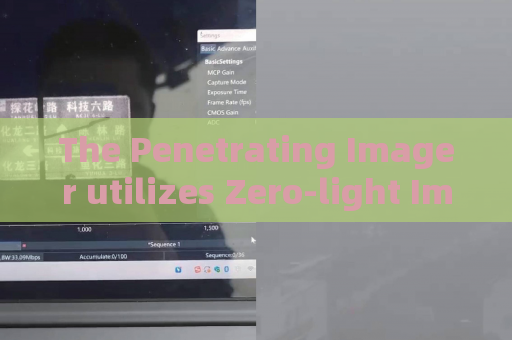
The Penetrating Imager utilizes Zero-light Imaging to observe hidden vehicle targets in field military security missions In field military security operations, the assessment of hidden vehicle targets often confronts a persistent challenge: a suspicious car parked in a dark tree line or a tinted SUV idling at a remote checkpoint may hold armed personnel, contraband, or explosive devices, yet its interior remains invisible to unaided vision. Ambient illumination is frequently insufficient during dusk, night, or under dense canopy, and reflective or tinted automotive glass further obscures any visual clue. Conventional daytime optics and standard night observation devices fail to deliver a clear, actionable image of the occupants or cargo. To close the distance for a physical check risks ambush and compromises the entire mission. This is the exact pain point that the Penetrating Imager is designed to resolve. The core capability of the Penetrating Imager lies in its laser range-gated imaging technology. Unlike passive devices that depend on available light, this active optical system emits brief, high-repetition-rate laser pulses toward the target and synchronizes a gated intensified camera to receive only the light reflected from a selected distance window. This gating mechanism suppresses backscatter from atmospheric particles and reflections from the glass surface itself, allowing the system to achieve through-glass surveillance of the vehicle cabin. The unit integrates a high-repetition-rate pulsed laser, an image-intensified gated camera with an MCP image intensifier, high-voltage and timing modules, a beam expander, and an imaging lens. It is a purely photonic approach, requiring no contact and emitting no detectable radio waves—only controlled laser illumination. In practice, the instrument provides a decisive tactical advantage for field military security teams. An operator can position the Penetrating Imager at a standoff distance, aim it at the side window or windshield of a suspected vehicle, and obtain a high-contrast image of the interior even in zero-light conditions. The system actively illuminates the scene with short laser pulses, so darkness becomes irrelevant. Vehicle window penetration works reliably on standard automotive glass, including lightly tinted windows, revealing the number of occupants, their positions, hand movements, or the presence of bulky objects on seats. Because the imaging is range-gated, the operator can adjust the timing to focus on the cabin while ignoring reflections from the outer surface. This reduces false readings and gives commanders real-time intelligence without exposing personnel to potential fire. The same field scenario also exposes the boundary of the technology: the Penetrating Imager can only see through optical media such as glass, not through opaque body panels or metal doors. Therefore, in a security checkpoint or a vehicle interdiction mission, the observation angle must be deliberately chosen to capture a window rather than the vehicle side armor. Under adverse weather, such as light rain, fog, or blowing dust, the range-gated design still helps overcome backscatter and maintains a usable image. The Penetrating Imager thus provides a practical, safe, and reliable means for hidden vehicle target observation in field military security missions, turning a previously blind spot into a controlled optical window.




