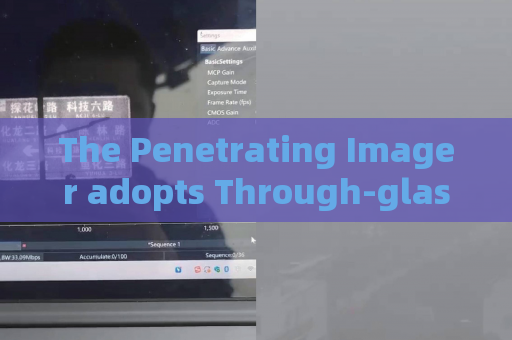
The Penetrating Imager adopts Through-glass Imaging Technology to implement long-distance monitoring of convoy vehicles. A convoy of vehicles moving through a checkpoint presents a unique surveillance challenge for security forces. The interior of each car, truck, or van is effectively sealed from outside view by tinted automotive glazing, reflective coatings, and the glare of ambient light. An officer on the ground cannot safely approach every vehicle to inspect the occupants, especially when the situation may involve armed individuals or hidden contraband. The standard method of hand-signaling a driver to stop and open the window places personnel in close proximity to unknown threats. Without the ability to see through glass from a distance, the officer must make decisions based on limited information. The Penetrating Imager addresses this exact problem by enabling long-distance visual inspection through vehicle windows. It removes the need for close physical contact during the initial assessment of a convoy, allowing a security team to observe inside a vehicle before any interaction occurs. The Penetrating Imager turns a dangerous unknown into a manageable and observable situation. The Penetrating Imager adopts Through-glass Imaging Technology to implement long-distance monitoring of convoy vehicles. This active optical imaging system relies on laser range-gated imaging, also known as gated viewing. Its core components include a high-repetition pulsed laser, an image-intensified gated camera with an internal MCP image intensifier, a high-voltage module, a timing module, a beam expander, and an imaging lens. During operation, the pulsed laser emits short bursts of near-infrared light toward a target vehicle. The gated camera opens its electronic shutter only for a precisely timed window, capturing light that returns from a narrow distance band corresponding to the vehicle's cabin. Reflections from the outer glass surface, rain droplets, or atmospheric particles arrive at different times and are excluded by the shutter. This mechanism effectively suppresses backscatter and delivers a high-contrast image of the interior. The through-glass surveillance function is optimized for windshields, side windows, and rear glazing, and the system's active illumination ensures reliable performance even under zero ambient light. The Penetrating Imager's design makes it a fully self-contained optical tool for covert observation through automotive glass. In a typical convoy monitoring operation, an operator positions the Penetrating Imager on a stable tripod at a concealed point near the checkpoint. The lens is aimed at the road, and the timing module is adjusted so that the range gate matches the distance to the targeted vehicle. As the convoy approaches, the monitor displays a crisp view of the cabin area without any visible light being emitted, so the occupants remain unaware that they are being watched. The operator can see whether the driver's hands are on the wheel, whether passengers are moving unexpectedly, or whether large objects are concealed under seats. The Penetrating Imager's long working distance keeps security personnel far from the vehicle, reducing the risk of a sudden attack. At the same time, the high frame rate allows continuous monitoring of a moving vehicle, updating the image fast enough to follow changes in posture or activity inside the car. The Penetrating Imager provides real-time visual intelligence that guides the decision to wave a vehicle through or direct it to a secondary inspection area. The performance of the Penetrating Imager remains stable under the harsh lighting conditions common at road checkpoints. Strong headlights from an approaching vehicle or direct sunlight reflecting off the windshield do not blind the system, because the range-gating principle only accepts photons that arrive within the selected time window. Rain, light snow, and heavy spray from the road are equally rejected, as droplets on the glass or in the air produce signals outside the gate. Even in fog or haze, the Penetrating Imager's ability to suppress backscatter delivers a clearer image than conventional optics. The Penetrating Imager delivers a reliable view through the side windows of a convoy even when weather conditions change rapidly. With its accurate timing and high-resolution intensified camera, the system also supports detailed observation of hand gestures and object shapes through deeply tinted glass. In this way, the device fulfills its role as a critical asset for long-distance convoy monitoring, providing actionable visual evidence without ever compromising the safety of the operator. The Penetrating Imager transforms a routine patrol into a precise, informed security operation.




