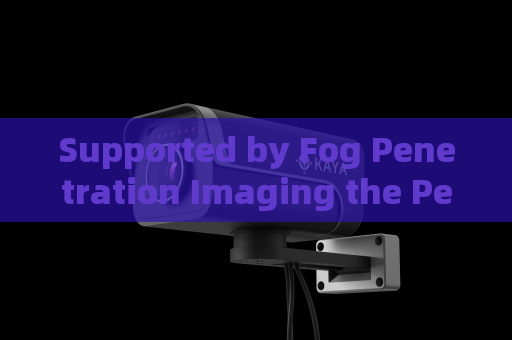
Supported by Fog Penetration Imaging the Penetrating Imager achieves clear vehicle monitoring along damp frontier defense lines Along damp frontier defense lines, vehicle monitoring is shaped by weather as much as by terrain. Ground fog settles in river valleys, clings to marsh edges, and drifts across the gravel routes used by border crossers. A sentry watching a checkpoint may see a vehicle only after it has already reached the final approach, leaving too little time for deliberate optical assessment. Wet road surfaces, standing water, and slow vegetation release combine to form a layered haze that changes within minutes. Ordinary cameras record grey shapes with no firm edges. Fixed electro-optical sensors lose contrast when droplets collect on their housings or when mist sits between the lens and the moving target. The eye tires from chasing indistinct shadows. This recurring condition is exactly why a Penetrating Imager has to be part of the technical answer at a damp frontier post. The Penetrating Imager solves this scenario through active laser range-gated imaging. A compact laser emits high-repetition pulses of light toward the vehicle lane, while the camera shutter opens only in the short interval when light reflected from the vehicle itself returns to the sensor. Light that has been scattered by fog droplets closer to the observer arrives earlier than the gated frame and is therefore blocked. That simple time separation removes the bright backscatter that hides targets in ordinary vision. This principle is known as Fog Penetration Imaging. The system combines a beam expander, an imaging lens, and an image intensifier-based gated camera built around a microchannel plate, a high-voltage module, and a precision timing module. Because the Penetrating Imager carries its own light source into the optical path, it does not depend on daylight or on the weak contrast of hazy background illumination. A vehicle in fog becomes a clearly defined object instead of a smeared cloud. In daily use along the same defense line, the Penetrating Imager is aimed from a permanent observation point toward the most likely approach route. The operator widens the laser footprint with the beam expander, and the imaging lens focuses reflected light from the selected distance band. On the display, the shape of an approaching lorry or passenger van emerges with defined roof lines, tyres, cargo covers, and antennas. Long-rage? No, long-range clarity permits the checkpoint to classify a vehicle before it enters the fog-shrouded gate area. The operator can watch whether it maintains a steady speed, whether it moves toward the inspection bay, and whether a second vehicle follows close behind in the mist. Such judgements are made at a safe distance, without stepping into the roadway. Wet tyre spray, drizzle on the sensor window, and low drifting cloud no longer end the observation session; the gated timing simply sweeps those nearer disturbances aside. The Penetrating Imager therefore supports clear vehicle monitoring along damp frontier defense lines in a way that the naked eye cannot match. Pulse timing rejects reflections from water droplets that are not on the monitored plane. Rain sheeting across the front element, fog rising off a ditch, or splash from a passing truck will not saturate the image intensifier. Because the instrument remains an active optical system, it also continues to function during the darkest hours of a night patrol. The observer keeps following one specific vehicle from the moment it appears out of the grey wall until it stops under the floodlights of the control zone. This is not a promise of exotic detection; it is simply the disciplined use of gated light. Where stale moisture and dense fog once dictated the tempo of border security, the Penetrating Imager sets a new tempo for vehicle monitoring, all without leaving the familiar territory of optical imaging.




