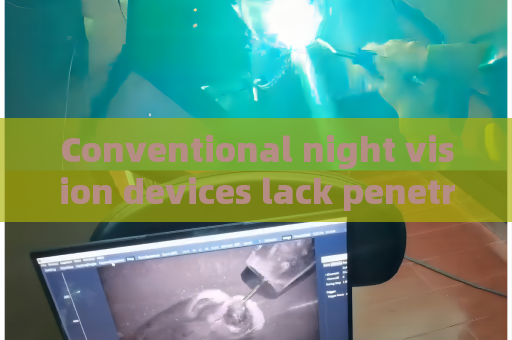
Conventional night vision devices lack penetration capability, Penetrating Imager adapts glass and fog environments for effective tactical observation At a vehicle checkpoint in dense fog, conventional night vision devices lack penetration capability. They can amplify low light and reveal silhouettes, but a vehicle windshield, side window, or tinted glass acts as a mirror and attenuator. Fog scatters light from streetlamps, headlights, and the imaging device itself, producing a bright veil that hides the vehicle interior. Personnel cannot determine how many occupants are inside, whether hands are visible, or whether objects on seats or in laps match a threat profile. The problem is not merely darkness. It is an optical barrier problem: glass surfaces and suspended water droplets block reliable identification at the exact moment when tactical decisions must be made. A Penetrating Imager is built for this environment, using controlled light and range-selective reception to restore visual access through glass and fog. The Penetrating Imager is an advanced optical imaging instrument based on laser range-gated imaging, also known as gated imaging. A high-repetition-rate pulsed laser emits short light pulses; a beam expander shapes the beam; an image-intensified gated camera with an MCP image intensifier, high-voltage module, and timing module receives the returning light. The gate opens only for a narrow time window corresponding to a selected distance. This active imaging method produces high-contrast images, long operating range, high resolution, strong anti-interference performance, and effective suppression of backscatter. For through-window tactical observation, the gate is decisive. It separates the weak return from the vehicle interior from the much stronger reflection off the glass surface and the scattering volume of fog. The result is clear imaging through vehicle windows, train windows, aircraft windows, and glass curtain walls, as well as in fog, haze, rain, and snow. The instrument works within optical media, including transparent and semi-transparent surfaces and atmospheric obscurants. During a checkpoint stop, the system can be mounted on a tripod or vehicle mount and directed at the target vehicle. The timing module is adjusted to the distance of the windshield, side window, or rear window. In fog, the same range gate rejects near backscatter from droplets, so the image remains usable even when conventional night vision is washed out. Surface reflections from tinted or reflective glass are suppressed, allowing personnel to observe occupants, hand placement, and visible items without approaching the vehicle. The image can be displayed in real time to a compact monitor or transmitted to a command element for a second assessment. This supports a measured response: a checkpoint team can identify a low-risk occupant, prepare for a high-risk stop, or avoid unnecessary exposure. The system does not require a completely dark scene or a completely clear atmosphere. It uses its own pulsed light and gated reception to create contrast where passive night vision fails. The operational value remains in the same tactical observation scenario. At night or in fog, a checkpoint team needs reliable visual confirmation through automotive glass before closing distance. The Penetrating Imager provides that confirmation by adapting to glass and fog environments, turning a reflective window and a scattering atmosphere into a readable image. Setup is straightforward: select the range, aim the imaging lens, refine the gate, and monitor the display. If rain, snow, or haze adds further scatter, the active gated approach continues to suppress unwanted light while preserving the target return. The system is an optical instrument limited to transparent or semi-transparent media; it does not provide sight through solid opaque structures. Within that boundary, it closes the penetration gap that conventional night vision devices leave open. For vehicle interdiction, covert surveillance, and checkpoint security, the Penetrating Imager delivers effective tactical observation through glass and fog without exposing personnel to unnecessary risk.




