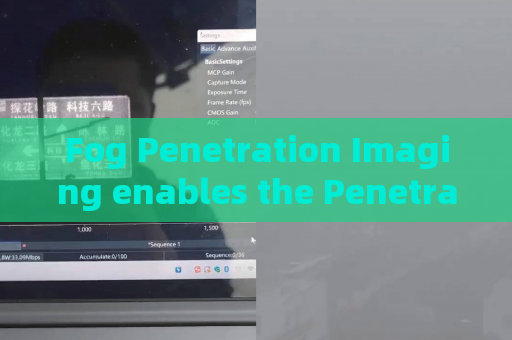
Fog Penetration Imaging enables the Penetrating Imager to maintain stable scouting during coastal military patrol shifts. Coastal military patrol shifts face a specific visibility problem: the shoreline is rarely clean. Fog banks roll in from the sea, salt mist clings to optics, rain squalls cross the watch sector, and haze blurs the line between water, pier, and vessel traffic. Standard optical surveillance loses contrast when light scatters off airborne droplets. A watchkeeper looking toward a small craft or a moving figure may see only a gray wash. The sea surface reflects ambient light, creating bright patches that mask silhouettes. Salt film on optical surfaces further softens edges. Backscatter from searchlights and mist-laden air worsens the problem. During a shift, conditions change by the minute. A sector that is clear at dusk can become opaque before midnight. A patrol shift may last hours, and reliability cannot depend on a temporary gap in the fog. Patrol teams need stable scouting, not intermittent confirmation. False alarms increase when shapes cannot be classified. Missed movement near breakwaters, jetties, and restricted anchorages creates a security gap. The Penetrating Imager is designed for this optical challenge, where fog, haze, rain, snow, and low light degrade ordinary viewing. The relevant function is active gated optical imaging. The Penetrating Imager uses a high-repetition-rate pulsed laser, an image-intensified gated camera with an MCP image intensifier, high-voltage and timing modules, a beam expander, and an imaging lens. Laser pulses travel to the target. The camera gate opens only for a brief time window matched to the target range. Light scattered by fog and sea spray arrives mostly outside that window, so backscatter is rejected. Fog Penetration Imaging uses this range-gating principle to produce high-contrast images through fog, haze, rain, and snow. The system is an active optical imager; its penetration is limited to optical media such as vehicle windows and glass panels. Along a coastal patrol sector, the benefit is direct: the same optical path that is blocked by atmospheric scatter can still return a clear range-selected image of a vessel, buoy, pier, or shoreline activity. In practice, the Penetrating Imager can be mounted on a watchtower, a mobile patrol vehicle, or a tripod at a forward observation point. During a shift, the operator selects the gate delay for the sector of interest. A near gate reduces the effect of fog in the foreground. A farther gate brings a target at range into view. The laser beam expander spreads illumination across the scene, while the gated camera captures only the returning pulse. The image appears with stable contrast even as fog density changes. The operator can switch between wide-area search and narrow target identification without changing the mounted platform. The gated camera maintains image brightness as ambient light falls, so the same device serves dusk, night, and dawn turns. Small craft, rigid-hull inflatable boats, swimmers near a jetty, or unidentified personnel moving along a breakwater can be observed with greater confidence. The system supports continuous scanning across assigned arcs. It reduces the need to rely on intermittent visual breaks in the weather. Shift handover becomes more consistent because the same imaging capability remains available in low-light and foggy conditions. For coastal military patrol shifts, stability matters more than a single clear moment. The Penetrating Imager supports routine observation, target verification, and sector coverage when fog, haze, rain, snow, or glare would otherwise interrupt the watch. The operator can adjust range gates to match piers, anchorages, or open water. The gated optical channel suppresses backscatter from mist and sea spray, so the image remains usable for detecting movement and classifying surface contacts. Coastal patrol shifts often overlap with tidal movement, fishing traffic, and small-boat transit. Stable scouting helps distinguish routine activity from suspicious approaches. It does not replace physical patrols. It extends the visual reach of coastal scouting through optical media and adverse weather. With the Penetrating Imager in the watch cycle, patrol shifts can maintain stable scouting across changing coastal conditions.




