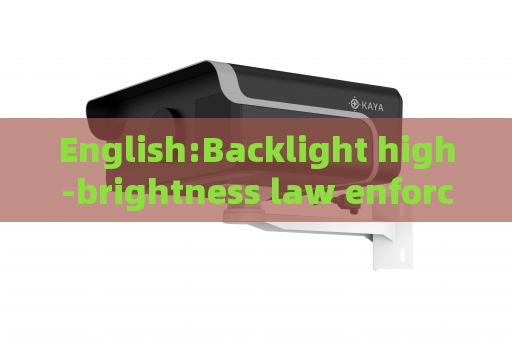
English: Backlight high-brightness law enforcement scenes, Penetrating Imager relies on Strong Light Suppression Imaging to deliver stable observation Backlight high-brightness law enforcement scenes are common at sunrise and sunset checkpoints, highway interdiction stops, port exits, and urban vehicle stops where the sun, headlights, or reflective glass sits directly behind the target. Officers need to assess occupants, hand placement, seat positions, and visible items through vehicle glazing before approaching. Conventional cameras and direct vision struggle because the exterior is far brighter than the cabin. Tinted windows, mirror-like reflections, rain, and road spray increase the contrast problem. Auto exposure locks onto the sky or headlights and drops the cabin into a dark silhouette. Exposure for the cabin blows out the background and destroys context. At night, high beams and LED signs create similar saturation. During pursuits, motion and vibration add further instability. Observation becomes unstable, intermittent, and difficult to document. In this environment, the Penetrating Imager provides an optical path to clearer assessment. It is an advanced optical imaging instrument using laser range-gated imaging. Its active approach rejects unwanted bright light and selects useful returns from the target scene, supporting stable observation when strong backlight would otherwise overwhelm conventional optics. The relevant function is Strong Light Suppression Imaging inside the Penetrating Imager. The Penetrating Imager combines a high-repetition-rate pulsed laser, an image-intensified gated camera with an MCP image intensifier, high-voltage module, and timing module, a beam expander, and an imaging lens. The pulsed laser sends short light pulses toward the scene. The gated camera opens for a very short interval timed to receive pulses returning from a chosen distance. Light from the sun, high beams, bright sky, wet glass, and reflective surfaces arrives outside that gate and is heavily suppressed. The receiver accepts light that has traveled the correct distance, so bright sources not synchronized with the gate are not amplified. This active imaging system delivers high-contrast images, long operating distance, high resolution, strong anti-interference behavior, and effective backscatter suppression. It can penetrate optical media such as vehicle windows, train windows, aircraft portholes, and glass curtain walls. It also maintains clear imaging through fog, haze, rain, and snow. Limits remain: the Penetrating Imager is an optical tool, not a device for opaque solid media. In field use, the Penetrating Imager can be aimed at vehicle glass from a protected angle while a stop or checkpoint is managed. Gate delay and gate width are adjusted to the windshield plane or cabin depth, so returning light from the interior is favored over glare from the glass surface and the background. through-window tactical observation becomes more consistent. Officers can read seat occupancy, arm movement, and whether visible objects are held or placed on the dashboard. The Penetrating Imager supports threat assessment, occupant identification, contraband screening, and safer approach planning. It helps maintain visual continuity when high-brightness backlight makes ordinary cameras unreliable. The image is not a substitute for legal authority or physical search. It is a tactical optical aid that improves decision time and situational awareness during rapidly changing enforcement activity. In a backlight-heavy stop, the operator can hold the view on the cabin while the background remains bright, preserving useful detail instead of losing it to glare. Performance depends on geometry, glass tint, weather, and correct gate control. A stable mount or steady handheld posture helps preserve resolution on small details. Operators tune the gate to reject returns from rain, haze, glass reflections, and distant bright sources. Correct gate control also reduces backscatter from rain and glass, a key benefit of active imaging. In backlight high-brightness law enforcement scenes, the Penetrating Imager relies on Strong Light Suppression Imaging to deliver stable observation. The Penetrating Imager keeps attention on the cabin rather than the blown-out background, giving officers clearer visual information for threat assessment and tactical choices. Its value is concentrated in one practical setting: seeing through automotive glass when strong light would otherwise hide what matters.




