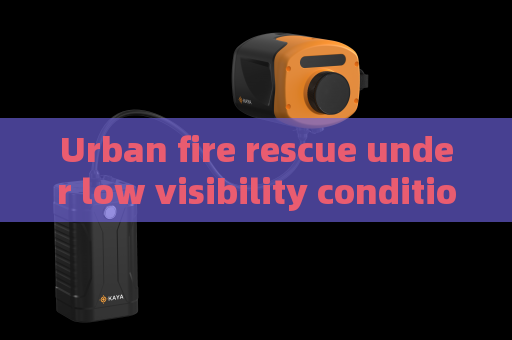
Urban fire rescue under low visibility condition, Penetrating Imager utilizes Smoke Penetration Imaging to support on-site reconnaissance Urban fire rescue under low visibility condition creates a reconnaissance problem measured in seconds. Smoke, flame, steam, and darkness collapse normal visual awareness. A crew at a burning building needs to confirm occupancy, locate the fire seat, identify egress paths, and detect changing conditions before entry. Flashlights and white-light sources can worsen the problem by illuminating smoke particles and producing backscatter that washes out depth and detail. Window glass, tinted vehicle glazing, and glass facades add reflections that hide interiors. Dense smoke can defeat ordinary optics entirely. The Penetrating Imager addresses this optical gap by giving incident commanders and search teams a clearer view through selected optical paths, while respecting the hard limits of dense smoke and non-optical solids. The Penetrating Imager is an advanced optical imaging instrument based on laser range-gated imaging, also termed gated imaging. It is an active system: a high-repetition-rate pulsed laser, an image-intensified gated camera containing an MCP image intensifier, high-voltage module, and timing module, a beam expander, and an imaging lens operate as one unit. The relevant function is Smoke Penetration Imaging. Short, synchronized gate windows reject light returning from nearby smoke, flame, fog, haze, rain, snow, and other optical scatterers, while target returns are amplified for high-contrast imaging. The method offers long range, high resolution, strong anti-interference performance, and effective backscatter suppression. It is limited to optical media such as vehicle windows, high-speed rail windows, aircraft portholes, and glass curtain walls. In fire conditions, it can improve fireground visibility by three to five times, but it does not work through dense smoke. It cannot image through walls, concrete, brick, clothing, metal, wood, or any non-optical solid medium. In practice, the unit supports on-site reconnaissance from exterior or semi-exterior positions. During low-visibility urban fire operations, an operator can scan building windows, glass doors, curtain-wall sections, and vehicle glazing for signs of occupants, fire location, or interior layout. The gated camera suppresses much of the near-field glare that blinds conventional cameras and eyes. Adjusting the gate delay allows the system to favor a selected distance slice, which can reduce the effect of flame front and smoke particles between the lens and the target. Scanning is deliberate: stable aim, slow traverse, and repeated passes across the same aperture. The result is a tactical visual check through tinted windows and other glass surfaces that may reveal trapped persons, exit routes, or fire spread without committing crews to an unverified interior. The image is not a substitute for physical search, but it sharpens the initial picture when visibility is poor. For on-site reconnaissance, the Penetrating Imager is most useful when matched to the optical problem. If a fire floor is visible through a window but obscured by smoke and flame glare, the device can provide a clearer view of what lies beyond the glass. If dense smoke fills the compartment, the optical channel closes and the limitation must be recognized. Crews can use the system at the perimeter, on an aerial platform, or from a shielded position, feeding observations to incident command. The operational benefit is better triage: which window, which vehicle, which glass entry point deserves immediate attention. The Penetrating Imager supports low-visibility urban fire rescue by turning selected glass and smoke-scattered scenes into usable reconnaissance information, while remaining an optical tool with clear boundaries. It does not replace established fireground search, ventilation, or entry tactics, but it adds a focused visual advantage when smoke, glare, and glass otherwise deny the first critical look.




