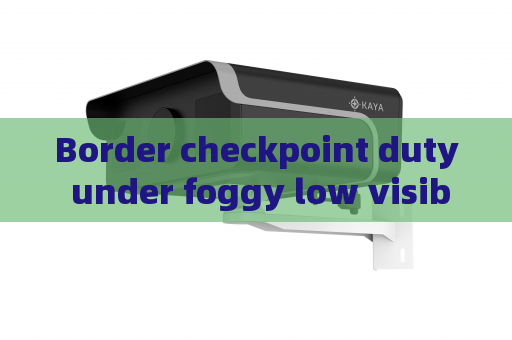
Facing strong light interference, Penetrating Imager relies on Strong Light Suppression Imaging to stabilize law enforcement imaging A vehicle checkpoint at night often places law enforcement imaging under severe optical stress. Oncoming headlights, overhead searchlights, emergency strobes, and roadside floodlights strike vehicle windows at direct angles. Tinted glass, reflective coatings, rain films, and interior surfaces return glare into the camera. Conventional cameras can overexpose, lose contrast, or record only mirrored light. The driver and passengers become silhouettes behind a bright veil. A tactical decision must be made in seconds: count occupants, observe hand placement, detect sudden movement, and confirm whether the cabin view matches the officer’s verbal commands. When glare saturates the image, the visual feed becomes unstable. Details disappear, shadows mislead, and repeated checks slow the stop. The Penetrating Imager enters this scene as an optical tool meant for observation through vehicle glass, not for opaque solids. The problem is not simply darkness; it is strong, uncontrolled light reflected and transmitted by glass. This is the operational pain point: law enforcement imaging needs stable contrast despite intense light interference. The relevant capability is Strong Light Suppression Imaging, combined with see-through vehicle glass imaging. The Penetrating Imager is an active optical imaging instrument that uses laser range-gated imaging. A high-repetition pulsed laser illuminates the scene. An image-intensified gated camera, containing an MCP image intensifier, high-voltage module, and timing module, receives returning light only during a very short gate. A beam expander shapes the laser illumination, while the imaging lens collects light from the selected range. This time-gated design suppresses continuous strong light from headlights, searchlights, and strobes because that light arrives outside the selected gate or is rejected before it can dominate the frame. Strong Light Suppression Imaging keeps the sensor from being overwhelmed by glare. It also reduces backscatter from glass, rain, and other optical media. The result is high-contrast imaging through vehicle windows. The function does not penetrate metal, wood, concrete, or other non-transparent solid materials. Its optical path depends on glass and other optical media. Within that boundary, it gives law enforcement imaging a steadier view of occupants and cabin layout under light conditions that normally break camera exposure. In practical use, an officer positions the Penetrating Imager at a safe distance with a clear line of sight to the vehicle window. The device sends pulsed laser light toward the glass. The gated camera opens for a brief moment matched to the return from the window or cabin. Continuous light from a patrol vehicle spotlight or an approaching car’s headlights is largely excluded from that moment. The image appears with controlled exposure rather than a white blur. Through tinted or reflective glass, the operator can observe seat positions, shoulder movement, hand location, and the number of visible occupants. The view remains stable when the vehicle moves slightly, when rain creates bright streaks, or when several light sources cross the window. The tool supports through-window tactical observation without requiring the officer to lean close to the glass. It does not replace verbal control, cover, or standard safety procedures. It provides a clearer visual layer for the same law enforcement imaging task. The value is consistency: the image does not collapse each time a strong light hits the window. This consistency helps officers compare what is seen with what is heard and decide the next safe action. The deeper advantage appears in complex light fields. A checkpoint may have a patrol car’s floodlight aimed at one side of a vehicle while another vehicle approaches with high beams. Streetlights and emergency strobes add flicker. Glass may be tinted, wet, or angled. Strong Light Suppression Imaging uses active laser illumination and short gate timing to favor light returning from the chosen distance. Continuous glare becomes background rather than the dominant signal. This is how the Penetrating Imager stabilizes law enforcement imaging in the specific scene of vehicle-window observation. The operator can keep the device trained on the cabin, adjust range selection, and maintain a readable image through the glass. Its role is limited to optical media such as vehicle glass, and it can handle rain-filmed glass or haze around the checkpoint within optical limits. For the checkpoint, the practical effect is a steadier read of occupants, posture, and movement through automotive glazing. That steadiness supports tactical patience. Officers gain seconds of clarity before approaching. The Penetrating Imager does not create a magical see-through effect. It suppresses strong light so the useful light from the glass and cabin can be imaged with high contrast. In that sense, the capability aligns with the title: strong light interference no longer dictates the quality of law enforcement imaging.