At customs checkpoints, the demand for rapid, non-intrusive security checks is a persistent challenge. Vehicles, cargo containers, and passenger compartments must be inspected for contraband, hidden compartments, or unauthorized items without causing delays or compromising privacy. Conventional methods often require physical opening of doors, trunks, or hatches, which is time-consuming and intrusive. Moreover, reflective surfaces such as tinted windows and strong ambient lighting can obscure visibility, forcing officers to rely on manual searches or secondary screening tools that slow the flow of traffic. The need for a solution that can see through transparent barriers while maintaining speed, accuracy, and operator safety is critical. This is where the Penetration Imager addresses a real operational pain point: providing a reliable view through vehicle glass and other optical media without physical contact or disassembly.
The Penetration Imager is an advanced optical imaging instrument that employs laser range-gated imaging technology, also known as gated imaging. Its system comprises a high-repetition-rate pulsed laser, an image-intensified gated camera (with an MCP image intensifier, high-voltage module, and timing module), a beam expander, and an imaging lens. As an active imaging system, it delivers high-contrast images with long detection range, high resolution, strong anti-interference capability, and effective suppression of backscatter. The key function relevant to customs security is its ability to penetrate optical media such as vehicle windshields, train windows, aircraft portholes, and glass partitions. By synchronizing the laser pulse with the camera’s gating window, the system eliminates glare and reflections from glass surfaces, allowing officers to clearly observe the interior of a vehicle or container. This capability directly solves the problem of obscured visibility caused by tinted glass, dirty windows, or bright external light—common obstacles at checkpoints.
In practical application, the Penetration Imager enables customs officers to perform a rapid visual scan of a vehicle’s cabin, cargo area, or passenger compartment without requiring occupants to exit or open doors. The operator simply aims the handheld or tripod-mounted unit at the target area; the system captures and displays a real-time image on a ruggedized screen. For example, a suspected vehicle with heavily tinted rear windows can be scanned in seconds, revealing hidden packages or modified compartments that would otherwise require a physical search. This non-intrusive approach reduces inspection time from minutes to seconds, maintains traffic flow, and minimizes privacy concerns since no physical intrusion occurs. The imager also functions effectively under adverse weather conditions such as rain, fog, or haze, which are common at border checkpoints, further enhancing its reliability. Officers can even scan through multiple glass layers—such as a front windshield and a rear window simultaneously—by adjusting the gating delay to focus on a specific depth.
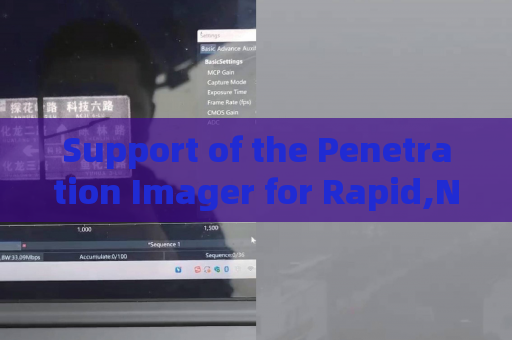
Further operational details include the ability to work at distances up to hundreds of meters, allowing pre-screening of vehicles approaching the checkpoint. The system’s immunity to backscatter from fog or rain ensures clear imaging even in poor visibility. The Penetration Imager’s laser emission is eye-safe at the operational distances used in customs environments, meeting safety standards for public use. The device can be integrated into fixed inspection lanes or deployed as a portable unit for secondary checks. By providing a rapid, non-intrusive view through optical barriers, the Penetration Imager transforms the customs checkpoint into a more efficient, secure, and respectful screening environment—directly supporting the mission of rapid, non-intrusive security checks.




