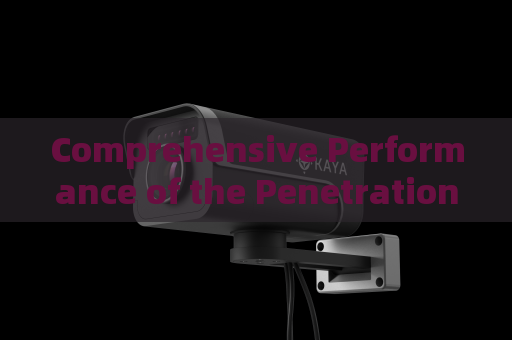
Comprehensive Performance of the Penetration Imager in Zero-Light Imaging, High-Glare, and All-Weather Tactical Environments Tactical reconnaissance in zero-light, high-glare, and all-weather environments presents a persistent challenge for law enforcement and military operators. During night operations, the absence of ambient illumination renders passive optical devices ineffective, forcing personnel to rely on artificial light sources that reveal their position. High-glare conditions—such as direct sunlight reflecting off vehicle windshields, building glass, or aircraft canopies—create blinding hotspots that obscure subjects behind optical media. All-weather adversities like fog, heavy rain, or blowing snow further degrade visibility by scattering light and reducing contrast. A critical scenario occurs when an operator must identify a suspect inside a parked car at night while the suspect’s vehicle headlights are on, or during a rainstorm with dense fog. Traditional night vision or thermal imagers struggle to see through glass, and bright reflections wash out image details. The penetration imager directly addresses these compounding visual obstructions by combining active illumination with time-gated detection, ensuring clear identification of targets behind optical barriers under any ambient condition. The core function that solves this problem is laser range-gated imaging, which allows the penetration imager to reject backscatter and ambient light interference. This active imaging system employs a high-repetition-rate pulsed laser whose short light pulses travel to the target and reflect back. An image-intensified gated camera, containing a microchannel plate intensifier, high-voltage module, and precise timing circuitry, opens its electronic shutter only during the exact moment when the reflected laser pulse arrives. By gating out light that scatters from fog, rain, smoke, or glare sources before and after the target return, the system achieves high-contrast imaging through optical media such as automotive glass, train windows, aircraft windshields, and glass curtain walls. In zero-light conditions, the laser provides its own illumination without emitting a visible beam, preserving tactical stealth. Under high-glare, the narrow temporal window rejects continuous ambient light, enabling the operator to clearly see subjects behind glass despite intense reflections. The penetration imager is inherently capable of all-weather operation because its active gating mechanism effectively overcomes the optical scattering that degrades conventional systems. In practical deployment, the penetration imager delivers consistent performance during nocturnal surveillance operations. An operator positioned at a safe distance can observe suspects inside a vehicle through tinted or rain-streaked windows, resolving facial features, hand movements, and concealed objects. Even when the target vehicle’s headlights or nearby streetlights create severe glare, the gating process strips away the interfering light, revealing the interior with sharp detail. During a foggy night mission, the imager extends effective range far beyond what the human eye or passive night vision can achieve, as the laser pulse and synchronized shutter work together to see through the optical haze. The system’s compact form factor allows it to be mounted on a tripod, vehicle platform, or handheld, with a simple user interface for adjusting gate delay to match varying target distances. Operators report that the penetration imager reduces identification time by eliminating the need to reposition or wait for changing light conditions, providing real-time actionable intelligence in hostile environments. Deepening the tactical application, the penetration imager proves indispensable in dynamic multi-threat scenarios that combine zero-light, high-glare, and adverse weather simultaneously. For example, during a counterterrorism operation in an urban setting at night, rain and fog may be mixed with vehicle headlights and strobe effects from emergency vehicles. The system’s ability to maintain focus and contrast through glass barriers—whether on a commercial aircraft windshield, a train window, or a building’s glass facade—allows operators to assess threats without exposing themselves. The penetration imager also enhances visibility through fire by a factor of three to five, assisting firefighters and tactical teams in locating individuals trapped behind vehicle windows or glass doors during blaze scenarios. However, it must be noted that the device cannot penetrate thick smoke, as smoke particles are non-optical media; only transparent or semi-transparent optical barriers such as glass, water droplets, and fog are effectively gated. By integrating this capability into standard tactical gear, the penetration imager revolutionizes close-quarters battle and surveillance by delivering reliable, high-resolution imagery exactly where traditional optics fail.




