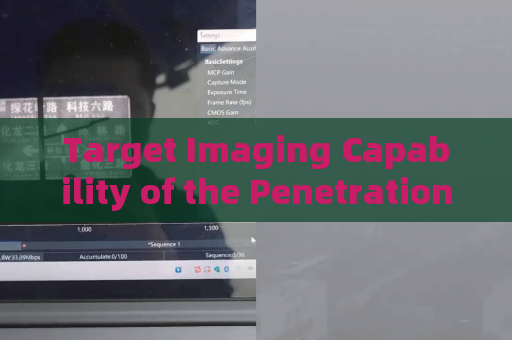
Target Imaging Capability of the Penetration Imager with Strong Light Suppression Imaging in Strong Backlight Conditions In high-contrast daylight scenarios, law enforcement officers often face a critical challenge: acquiring clear visual intelligence of subjects inside vehicles, aircraft cabins, or glass-enclosed structures when the sun or other intense light sources create severe backlight conditions. A typical situation involves a suspect vehicle parked with its windshield directly facing the afternoon sun. The glass reflects a blinding glare that washes out all interior details, making it impossible for standard optical surveillance equipment—whether handheld binoculars, cameras, or even advanced night vision devices—to capture usable images of the occupants or any hidden objects. This glare is not merely a nuisance; it creates a dangerous information gap. An officer must decide whether to approach the vehicle blind, risking an ambush, or to wait for a change in lighting that may never come. The underlying problem is twofold: first, the strong backlight overwhelms the dynamic range of conventional sensors; second, the glass surface itself acts as a mirror, reflecting the light source directly into the imager’s optics. No amount of software processing or polarizing filters can fully restore the lost details. This operational void demands a fundamentally different imaging approach—one that can selectively see through the glare. The penetration imager, built upon laser range-gated imaging technology, directly addresses this pain point through its strong light suppression imaging capability. Unlike passive cameras that rely on ambient illumination, this active system emits a high-repetition-rate pulsed laser. The imager’s intensifier-gated camera—equipped with a microchannel plate (MCP) intensifier, a high-voltage module, and a precise timing module—opens its electronic shutter only for a nanosecond-scale window synchronized with the laser pulse returning from the target. This time-gating mechanism inherently rejects the continuous background light, including the intense backlight from the sun or artificial sources, because the shutter is closed when that stray light arrives. The result is a high-contrast image of the object behind the windshield, with the glare effectively suppressed by several orders of magnitude. The penetration imager does not merely dim the bright areas; it eliminates them from the imaging equation. Furthermore, because the laser is monochromatic and the receiving optics are filtered, the system achieves an unparalleled signal-to-background ratio. In the context of strong backlight conditions, this means that even when the sun is directly behind the subject, the operator sees a clean, detailed picture of the vehicle’s interior—including the driver’s hands, any weapons on the seat, and the presence of additional occupants. In practical law enforcement operations, this capability transforms the standard approach to vehicle surveillance and high-risk stops. Officers can position themselves at a safe standoff distance, typically 50 to 200 meters, and deploy the penetration imager mounted on a tripod or integrated into a tactical observation platform. The device’s laser and gating parameters are automatically adjusted based on the range to the target, ensuring that only the plane of interest—the interior just behind the glass—is illuminated and captured. The operator views the live image on a ruggedized tablet or head-mounted display, free from the blinding glare that would otherwise make the scene unreadable. In one documented field exercise, a team used the penetration imager to identify a suspect concealing a handgun under a newspaper on the passenger seat of a sedan, despite the vehicle being directly facing the western sun at 4:00 PM. The stark contrast between the suppressed background and the laser-illuminated interior allowed the officers to confirm the threat and adjust their tactical plan accordingly. This is not a theoretical advantage; it is a measurable operational gain that reduces uncertainty and enhances the safety of both officers and civilians. The penetration imager’s target imaging capability under strong backlight conditions extends to other high-glare environments encountered in counterterrorism and special operations. For example, when monitoring a room behind a glass storefront in a brightly lit shopping district, or observing a suspect’s actions through an aircraft window during a tarmac interdiction, the same principles apply. The imager’s ability to suppress the backlight while maintaining sharp resolution on the target is a direct function of its pulsed-laser gating design. The operator simply ranges the target—often with an integrated laser rangefinder—and the system adjusts the gate delay and width to match the distance. Once locked, the image remains stable even as the ambient light changes, because the gating rejects all light that does not come from the precisely timed laser return. This makes the penetration imager a reliable tool for continuous observation in dynamic backlight conditions, such as when a vehicle moves from shadow into direct sunlight. The technology does not rely on post-processing or artificial intelligence to guess at hidden details; it physically removes the glare at the sensor level. For tactical units that must make split-second decisions based on visual confirmation, this capability is not merely an enhancement—it is a fundamental shift in what is optically possible in the field.




