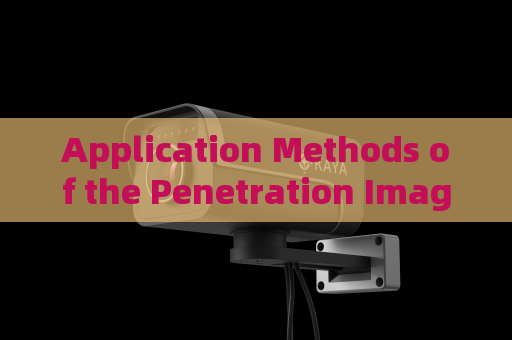
Application Methods of the Penetration Imager for Helping Law Enforcement Covertly Gather Evidence Before Taking Action
A tactical operation targeting a vehicle-borne threat often demands silent intelligence before any breach. Law enforcement officers face a critical challenge: a suspect inside a car may possess a weapon, a hostage, or contraband, yet the vehicle’s windows—tinted, reflective, or covered with condensation—obscure every detail. Standard binoculars or cameras fail against glass glare and stray sunlight, while approaching the vehicle risks alerting the subject. The inability to confirm the suspect’s hand position, the presence of an accomplice, or the exact location of a firearm leaves the entry team guessing, increasing both tactical danger and legal uncertainty. This gap in covert observation is where the penetration imager becomes a necessity rather than an option.
The penetration imager, an advanced optical instrument employing laser range-gated imaging technology, directly addresses this pain point. Composed of a high-repetition-rate pulsed laser, an intensified gated camera (with MCP, high-voltage module, and timing circuitry), a beam expander, and an imaging lens, it operates as an active imaging system. Its key capability lies in penetrating transparent optical media such as automotive safety glass, train windows, and aircraft portholes. More critically, it suppresses backscatter from rain, fog, mist, or even snow on the glass surface, delivering high-contrast images despite adverse weather. For a law enforcement team positioned at a safe standoff distance—say, 50 meters—the device can selectively gate the laser pulse to illuminate only the interior plane of the vehicle, rejecting reflections from the outer glass layer. This yields a crisp, real-time view of occupants, objects on seats, and movement, all without any emission that would tip off the target.
In practical application, the operator deploys the penetration imager from a concealed observation post, aligning the optics through a rifle scope-style sighting system. Once the suspect vehicle is acquired, the range-gating delay is adjusted to focus on the depth of the passenger compartment. The operator then observes the live feed on a small handheld monitor, noting hand placement near the waistband, the silhouette of a shotgun beneath a jacket, or the subtle shift of a hostage’s position. Because the system operates solely in the optical spectrum—using pulsed laser light and not any form of radiation or penetrating rays—it leaves no electronic signature detectable by counter-surveillance gear. The gathered evidence, such as still images or short video clips, can be wirelessly transmitted to the command post before a dynamic entry is authorized. This sequence ensures that probable cause is documented visually, reducing reliance on subjective witness statements and strengthening the legal basis for immediate action.
An additional layer of tactical advantage emerges when the operation unfolds under challenging atmospheric conditions. Heavy fog, driving rain, or even a fire-adjacent scene often degrades conventional optics to near-uselessness. The penetration imager, however, maintains a three- to five-fold improvement in visibility through smoke-free haze or water droplets, as long as the optical medium itself remains transparent. For example, during a rainy night raid, officers using the device could still distinguish a suspect reaching for a center console—behavior that a driver behind rain-streaked glass would otherwise appear as a blurred shape. By gating the laser to a precise time window corresponding to the interior depth, the system eliminates the blinding effect of water droplets on the glass surface. This consistent imaging capability transforms a high-risk uncertain approach into a calculated, evidence-informed maneuver, preserving both officer safety and operational integrity.




