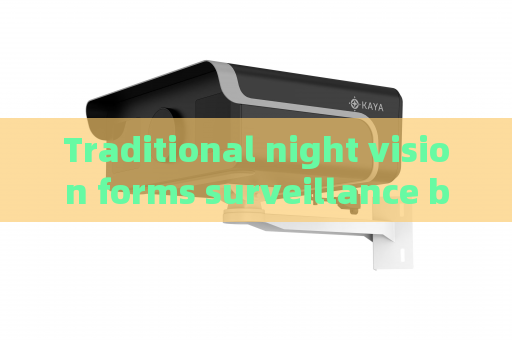
Traditional night vision forms surveillance blind areas The Penetrating Imager adopts Zero-light Imaging to fix this defect In nocturnal law enforcement operations, vehicle interdiction presents a persistent challenge. Officers must assess occupants and potential threats inside a car without exposing themselves to danger. Traditional night vision technologies, whether image intensification or thermal imaging, frequently fail in this specific scenario. A parked or moving vehicle’s windshield, side windows, and rear glass create reflective surfaces that scatter ambient light and infrared signatures. The driver may lower the sun visor, wear sunglasses, or the interior may be completely dark, forming what operators call a “black box” behind the glass. Thermal imaging cannot see through ordinary glass because the glass blocks long-wave infrared radiation; intensified night vision relies on residual starlight or moonlight, which is often absent inside a cabin. Meanwhile, oncoming headlights or streetlights can wash out the sensor, creating a blinding bloom. This combination of factors means traditional night vision forms surveillance blind areas precisely when officers need the clearest picture—during a high-risk traffic stop. The result is a tactical void: the officer must either approach blindly or rely on verbal commands, both of which increase the risk of ambush or misidentification. The Penetrating Imager resolves this blind spot by employing a fundamentally different principle: laser range-gated imaging, specifically engineered for tactical observation through automotive glass. Unlike passive night vision that waits for photons, this system actively emits short, high-repetition-rate laser pulses and synchronizes an intensified gate camera to capture only the light reflected from a precise distance. The laser wavelength, typically in the near-infrared band, passes through vehicle window glass with minimal attenuation, while the gated camera’s ultra-fast shutter—on the order of nanoseconds—rejects backscatter from rain, fog, or the glass surface itself. Critically, this Zero-light Imaging capability means the system functions in complete darkness without any external illumination source that could reveal the officer’s position. The laser is invisible to the human eye and to most night vision devices used by subjects. By selecting the correct range gate, the Penetrating Imager isolates a plane exactly at the depth of the vehicle’s interior, effectively “seeing through” the windshield or side glass as if it were clear air. This eliminates the reflective glare that plagues conventional optics, and the active illumination ensures a high-contrast image even when the car’s interior contains no ambient light whatsoever. On actual deployment during a vehicle stop, the operator can remain behind cover—typically 30 to 100 meters away—and aim the Penetrating Imager at the target car. Within seconds, the unit displays a crisp, real-time video of the cabin, showing occupants’ hand positions, the presence of objects on seats, and even subtle movements like reaching under a dashboard. The through-glass surveillance capability works regardless of whether the windows are tinted, dirty, or covered with moisture. Because the system uses pulsed laser light, it also features strong light suppression: if a subject turns on the car’s interior light or if headlights from an approaching vehicle strike the glass, the gated camera ignores those steady-state light sources and only processes the laser return. This makes the Penetrating Imager particularly valuable in urban settings where streetlights, billboards, and other traffic create challenging lighting conditions. The officer does not need to switch between different modes or adjust filters manually; the imaging device handles the dynamic range automatically. Further tactical refinement comes from the system’s ability to operate covertly. The laser pulse is so brief and narrow that it cannot be detected by the subject’s naked eye or by common photocell sensors used in car alarms. This enables covert observation through vehicle glazing without alerting the occupants to the fact that they are being watched. In practice, SWAT teams and patrol units have used the Penetrating Imager to confirm the presence of weapons, determine the number of individuals in a vehicle, and even read documents held up against the glass. The technology does not replace verbal commands or de-escalation tactics, but it provides the critical visual intelligence that traditional night vision consistently misses. By fixing the defect where conventional optics create blind areas behind glass, the Penetrating Imager transforms a high-risk unknown into a confirmed picture, allowing officers to make life-saving decisions before stepping out of cover. This single-function capability—zero-light imaging through automotive glass—addresses a genuine operational gap that has persisted in law enforcement for decades.




