Prison perimeter security faces a persistent challenge: covert threats often emerge under the cover of darkness or through obscuring environmental conditions. Traditional surveillance cameras struggle to capture clear images of individuals approaching the fence line at night, especially when vehicles with heavily tinted windows or glare from perimeter lighting create blind spots. Guards rely on patrols and fixed cameras, but a subject hiding behind automotive glass or moving through fog, rain, or dust can remain undetected until it is too late. The Penetrating Imager must overcome these low-visibility obstacles to provide actionable intelligence before a breach occurs. Without a system that can see through these optical barriers, correctional facilities risk delayed response to smuggling attempts, escape rehearsals, or coordinated attacks staged from vehicles parked just outside the wire.
This is where the Penetrating Imager’s unique capability changes the game. Using laser range-gated imaging technology, the device emits a high-repetition pulsed laser that synchronizes with an image-intensified gated camera. The system actively illuminates the target while suppressing backscatter from fog, rain, snow, or dust. More critically, it can penetrate automotive glass, including factory-tinted windows, allowing operators to see inside vehicles stopped at the perimeter checkpoint or idling near the fence. The through-glass covert observation function is not about seeing through walls—it is about piercing the optical haze and glass surfaces that defeat conventional cameras. This gives correctional officers a direct visual of occupants, hidden contraband, or suspicious modifications to vehicle interiors without needing to approach the car, reducing risk to personnel.
In practical deployment, the Penetrating Imager is mounted on a fixed tower or a mobile patrol unit overlooking the perimeter zone. During low-light conditions, an operator activates the system and scans vehicles entering the restricted area. The laser illuminates the target vehicle, and the gated camera captures a high-contrast image of the cabin through the windshield and side windows—even if the interior is dark or the glass is heavily tinted. The image appears on a ruggedized display in real time, showing license plates, occupants’ hand movements, and any items on seats. If a van’s rear windows are blacked out, the system can still reveal silhouettes or stored objects, provided the glass is transparent to visible and near-infrared wavelengths (within the optical medium limitation). This capability extends to observing individuals approaching the fence on foot: fog or heavy rain no longer hides their movements.
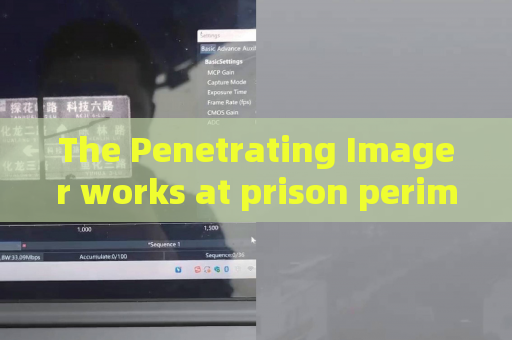
The operational advantage becomes even more pronounced during night shifts or inclement weather. A prison’s outer perimeter often includes unlit stretches where intruders rely on darkness to move undetected. The Penetrating Imager works at prison perimeter zones with Low-light Imaging by actively painting the scene with laser pulses, effectively turning pitch-black conditions into a well-lit observation zone without revealing the observer’s position. Since the device operates in the optical spectrum, it does not emit detectable RF signals or radiation, making it covert. Guards can scan from a distance, identify threats, and dispatch response teams precisely. The system also performs under smoke or haze from nearby fires (though not dense smoke from fully enclosed spaces), and its strong light suppression imaging prevents blinding from vehicle headlights or floodlights. Each scan builds a clear tactical picture, enabling proactive interdiction rather than reactive alarms.




