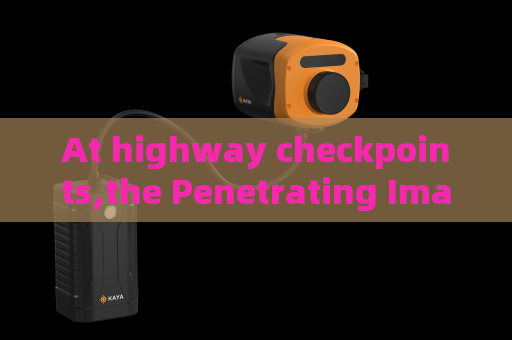
At highway checkpoints, law enforcement officers face a critical challenge: visually inspecting vehicle interiors without compromising safety or operational tempo. Drivers often roll down windows only partially, or vehicles have heavily tinted glass that obscures the view. Opening doors or forcing occupants to exit can escalate tensions, waste time, and create dangerous exposure to potential threats. The inability to see through automotive glass quickly and discreetly leaves officers vulnerable to concealed weapons, contraband, or hostile individuals hiding in the back seat. This gap in situational awareness at checkpoints is a persistent problem that the Penetrating Imager is designed to resolve. The Penetrating Imager addresses this exact vulnerability through its core capability of Vehicle Window Penetration. This advanced optical instrument employs laser range-gated imaging technology—a high-repetition-rate pulsed laser paired with an intensified gated camera. The system fires short laser pulses toward the vehicle window, and the camera’s gate opens only when the reflected light from objects inside the cabin returns. This precisely timed gating mechanism blocks glare from the windshield, reflections off dashboard surfaces, and ambient light interference. Unlike passive cameras that fail in low-light conditions or through darkly tinted glass, the Penetrating Imager produces clear, high-contrast images of the interior. This allows for tactical observation through automotive glass without requiring the driver to lower the window or open the door. In practice, the device is deployed from a fixed position near the checkpoint lane or from a patrol vehicle at a safe standoff distance—typically 10 to 50 meters. An operator aims the imager at the side or front window and, within seconds, a live video feed of the vehicle cabin appears on the display. The image reveals the number of occupants, their hand positions, and any visible objects such as weapons or suspicious packages. The system works equally well in bright sunlight, nighttime darkness, rain, fog, or through heavy precipitation, thanks to its active illumination and the time-gated rejection of backscatter. Officers can assess threats before making physical approach, allowing them to make tactical decisions—such as calling for backup or directing the vehicle to a secondary inspection area—without ever breaking the glass or altering the driver’s behavior. The Penetrating Imager is strictly limited to optical media: it can only see through glass such as automotive windows, aircraft canopies, or building glass. It cannot penetrate metal, fabric, body panels, or any opaque material—a design that aligns with legal and operational boundaries at highway checkpoints. This selective visibility is precisely what the mission requires: it reveals the cabin interior without probing beyond the transparent surfaces. The system’s Low-light Imaging and Strong Light Suppression Imaging capabilities extend its utility to nighttime operations and sun-glare conditions, eliminating common imaging failures. By integrating the Penetrating Imager into checkpoint protocols, agencies gain a decisive advantage in officer safety, faster vehicle processing, and reduced escalation risks. This technology transforms a routine yet dangerous task into a controlled, informed procedure that protects both law enforcement and the public.




