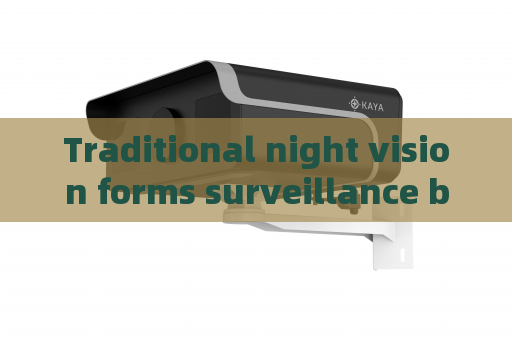
Traditional night vision forms surveillance blind areas The Penetrating Imager adopts Zero-light Imaging to fix this defect In covert police operations, nighttime surveillance of vehicles is fraught with a critical flaw. Conventional night vision devices—whether image intensifiers or thermal imagers—struggle when tasked with observing targets inside cars. The headlights, streetlights, or even the operator’s own illuminators reflect off automotive glass, creating harsh glare and backscatter that wash out the scene. Worse, tinted windows absorb or scatter ambient light, leaving the interior completely invisible. This is the exact pain point: the glass itself becomes an impenetrable barrier, forming a “surveillance blind area” around every vehicle. Officers are forced to close in dangerously, use physical breaches, or risk losing the target entirely. The Penetrating Imager directly addresses this defect by employing a fundamentally different approach: Vehicle Window Penetration imaging that works even in absolute darkness. The Penetrating Imager is an advanced optical instrument built on laser range-gated imaging technology. Its core components—a high-repetition-rate pulsed laser, an image-intensified gated camera with an MCP intensifier, a timing module, a beam expander, and an imaging lens—work in concert to eliminate the glass barrier. Instead of flooding the scene with continuous light, the system fires nanosecond laser pulses and opens the camera shutter only for the brief moment when reflected light returns from the target behind the glass. This gates out all backscatter from the window surface, including reflections, dirt, and moisture. In complete darkness—Zero-light Imaging—the penetrating beam sees through automotive glass as if it were clear air. The result is a crisp, high-contrast image of the vehicle’s interior, with enough resolution to identify occupants, their movements, and any objects in hand. In a real-world stakeout scenario, the improvement is immediate and dramatic. An officer positioned 100 meters away can deploy the Penetrating Imager on a tripod or mount it to a vehicle. Without any external illumination, the system reveals the silhouettes and detailed facial features of subjects inside a sedan, even through heavily tinted rear windows. The operator can track hand gestures, observe whether a weapon is being drawn, or confirm a suspect’s identity before making entry. Because the technology overcomes fog, rain, and snow as well—thanks to the same range-gated principle that rejects particulate scatter—this surveillance capability remains stable in adverse weather that would cripple traditional night vision. The unit’s strong light suppression also prevents sudden headlights from blooming the image, so a suspect switching on an interior dome light does not blind the operator. Further refinements enhance operational tact. The Penetrating Imager’s digital output can be fed directly into a command-and-control tablet, allowing a supervisor to view the same real-time feed without being near the optic. Its gated timing can be adjusted on the fly to compensate for different glass thicknesses or to zoom in on a specific seat—say, the driver’s side versus the rear compartment. In counter-surveillance missions, this capability enables covert observation through vehicle glazing without any telltale illumination; the laser is invisible to the naked eye and operates at eye-safe power levels. The device thus fills the exact gap left by traditional night vision, turning a previously impenetrable blind area into a fully observable space. The Penetrating Imager does not just fix a defect—it redefines what is possible in nighttime vehicle surveillance.




