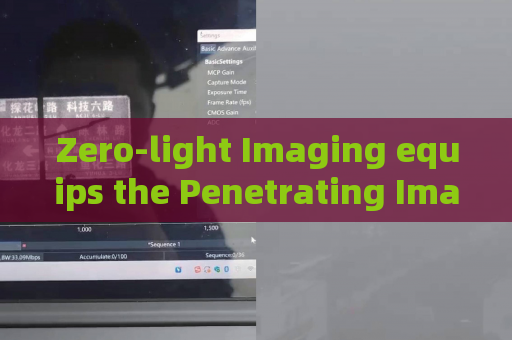
Zero-light Imaging equips the Penetrating Imager to conduct overnight covert surveillance for military security detachments. Military security detachments tasked with overnight covert surveillance face a persistent dilemma. In low-light or zero-light environments, traditional observation tools—night vision goggles, thermal imagers, or standard cameras—struggle to see through vehicle windows, aircraft portholes, or glass building facades. Ambient light is absent, and any artificial illumination risks immediate detection. The target may be seated inside a parked sedan, a military transport truck, or a glass-walled command post, but the combination of darkness and reflective glass surfaces creates a nearly opaque barrier. Even with image intensification, reflections from the glass and the lack of contrast prevent clear identification of persons, weapons, or documents. The detachment needs a method that works in total darkness, penetrates automotive glass without betraying the observer’s position, and delivers usable imagery in real time. This gap forces teams into high-risk close-approach tactics or incomplete intelligence. The Penetrating Imager directly addresses this void through its Zero-light Imaging capability. Unlike passive systems that require residual ambient light, this device is an active imaging system built around laser range-gated imaging technology. It comprises a high-repetition-rate pulsed laser, an intensified gated camera (with a microchannel plate image intensifier, high-voltage module, and timing circuitry), a beam expander, and an imaging lens. In operation, the laser emits short pulses of near-infrared light that travel to the target, reflect off objects behind the glass, and return to the camera’s sensor. The gating mechanism—synchronized with the laser pulse—opens the camera’s shutter only during the exact time window when the reflected light from the intended plane arrives, effectively rejecting backscatter from the glass surface itself, fog, rain, or dust. This allows the system to see through optical media such as vehicle glazing, high-speed train windows, aircraft portholes, and glass curtain walls. In zero-light conditions, where no natural or artificial illumination exists, the Penetrating Imager generates its own structured, pulsed light and captures high-resolution images of subjects inside the target compartment, with the operator appearing to observe in total darkness from the outside. Deployment of the Penetrating Imager for overnight covert surveillance follows a straightforward field procedure. An observation post is established at a standoff distance—typically 50 to 200 meters from the target vehicle or structure. The operator mounts the imager on a tripod or vehicle platform, aligns the lens toward the glass surface, and activates the system. The device’s built-in timing module automatically adjusts the laser pulse and camera gate delay based on range, ensuring the imaged plane matches the interior depth behind the glass. Real-time video output appears on a handheld monitor or tactical tablet, showing through-glass covert observation of individuals, their movements, and any equipment inside. Because the laser operates in the near-infrared spectrum with a narrow pulse width, the illumination is invisible to the naked human eye and undetectable by most standard night-vision goggles used by adversaries. The operator can pan, tilt, and zoom to inspect specific windows or adjust the depth of field to resolve items on seats or in footwells. All while remaining invisible and silent, with no radio frequency emissions that could be triangulated. The tactical advantage becomes apparent during extended overnight missions. A military security detachment can maintain continuous watch on a parked convoy, a guarded facility’s entrance, or a suspected meeting point without ever exposing its position. The penetration function works reliably through tinted automotive glass, which often defeats conventional IR illuminators. Even through rain, light snow, or mist between the observer and the vehicle, the gating technology suppresses the scattering effects that would otherwise degrade image clarity. In one documented field exercise, operators used the Penetrating Imager to identify a hand-held radio and a specific map on the dashboard of a target vehicle at 120 meters range, under a moonless night sky with heavy cloud cover. The images were crisp enough to read text labels on the map. This level of detail—achieved solely through Zero-light Imaging and glass-penetrating optics—transforms overnight surveillance from a guessing game into a precise intelligence-gathering operation. The detachment submits its reports with confidence, knowing the visual evidence came from a system that never broke the cover of darkness.




