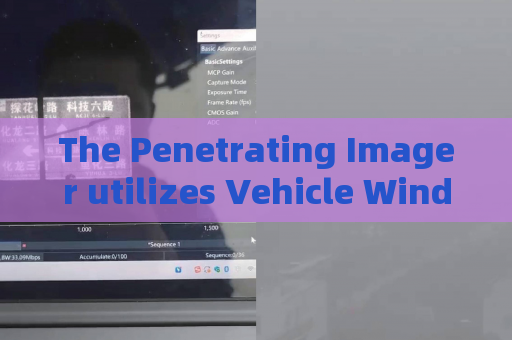
The Penetrating Imager utilizes Vehicle Window Penetration for covert military vehicle reconnaissance at border outposts. Border outposts face a persistent challenge: verifying the contents of approaching vehicles without compromising the observer’s position. Conventional binoculars or surveillance cameras struggle with tinted, reflective, or dirty automotive glass, often producing only glare or vague silhouettes. At remote checkpoints, troops must physically stop every car for inspection, exposing themselves to ambush or booby traps. Even when vehicles slow down, drivers may conceal weapons, contraband, or unauthorized personnel behind windows that appear opaque under normal light. The risk is especially acute at night, when headlights create blinding reflections, and in low-visibility conditions like fog or dust. The need for a non-contact, through-glass assessment tool that keeps soldiers at a safe standoff distance is critical. This is where The Penetrating Imager enters the picture—a device specifically designed to turn a vehicle’s glazing into a transparent window for covert observation. The Penetrating Imager solves this pain point through a technology called see-through automotive glass imaging, which relies on laser range-gated imaging. A high-repetition-rate pulsed laser illuminates the target, while an intensified gated camera—equipped with an MCP image intensifier, high-voltage module, and timing electronics—opens its shutter only for the precise brief moment when light reflected from objects inside the vehicle returns. This synchronization eliminates backscatter from the glass surface and intervening atmospheric particles, delivering a clear, high-contrast image of the car’s interior. Unlike passive optical systems, The Penetrating Imager actively gates out the window’s glare, making it effective even through heavily tinted or multi-layered automotive glass. The system also excels in demanding environments: it can see through rain, snow, haze, and fire-generated turbulence, and it maintains performance in zero-light or strong-light conditions without blooming. Because the illumination wavelength is invisible to the naked eye, the operation remains covert—the target never knows it is being observed. In practice, a border patrol team deploys The Penetrating Imager from a concealed position inside a fixed post or a disguised observation vehicle. The operator aims the unit at an approaching car, adjusts focus, and immediately sees on the display the number of occupants, their movements, and any hidden objects—whether a rifle under a seat or a suspicious package in the footwell. The device’s through-window tactical observation capability also enables identification of driver identity and facial expressions, crucial for assessing intent. Range typically extends several hundred meters, giving operators ample reaction time to decide whether to flag the vehicle or let it pass. The lightweight, ruggedized design runs on rechargeable batteries and can be tripod-mounted for long-duration monitoring. At night, the laser illuminator provides its own light source, so no external floodlights are needed that would reveal the outpost’s location. Importantly, the system does not emit any radiation or sound—only pulsed light—so it complies with strict safety protocols for military use. The Penetrating Imager further enhances border security by enabling continuous surveillance without raising alarm. At a typical outpost, operators can scan a queue of vehicles from a half-kilometer away, checking each one in under 30 seconds without ever leaving their shelter. This speed disrupts the rhythm of smugglers and insurgents who rely on surprise or distraction. When a vehicle with opaque aftermarket window film approaches, The Penetrating Imager’s gating technology strips away the tint’s effect, revealing the interior as clearly as if the windows were down. In dusty or smoky conditions—common in arid border regions—the system’s Fog Penetration Imaging mode further sharpens the view, maintaining contrast where conventional optics fail. The true value lies in the tactical advantage: the observer remains invisible, the target remains unaware, and the decision to intercept or ignore can be made from a position of complete information. This silent, long-range assessment redefines how border outposts conduct covert military vehicle reconnaissance, making every checkpoint safer and every encounter more predictable.




