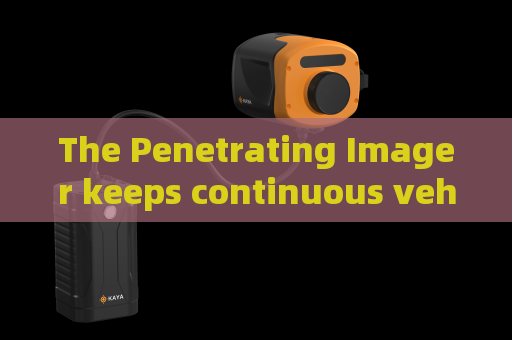
The Penetrating Imager keeps continuous vehicle observation when encountering mild fog on provincial traffic arteries Provincial traffic arteries often become treacherous when mild fog rolls in, reducing visibility to a dangerous haze. Traditional optical surveillance systems—closed-circuit television cameras, standard optical sensors, or even thermal imagers—struggle under these conditions. Thermal imagers, while useful in darkness, cannot see through fog because water droplets scatter long-wave infrared radiation. Conventional cameras are rendered nearly useless as light diffuses and contrast collapses. This creates a critical gap for law enforcement and traffic management agencies that rely on uninterrupted observation of vehicle movements, license plates, and driver behavior. During a routine patrol or a covert surveillance operation, the inability to maintain visual contact with a suspect vehicle through fog can mean losing the trail entirely. The problem is not just about seeing—it is about maintaining continuity of observation over time, tracking a vehicle without breaks in the feed. Fog Penetration Imaging becomes the only viable solution when every second of lost visibility could compromise a pursuit or a roadside safety check. The Penetrating Imager directly addresses this pain point through its core technology: laser range-gated imaging. This active imaging system employs a high-repetition-rate pulsed laser synchronized with an intensified gated camera. By emitting extremely short laser pulses and opening the camera’s gate only when the reflected light from the target returns, the system effectively eliminates backscatter from fog particles between the imager and the vehicle. The result is a high-contrast, high-resolution image that cuts through the haze. Unlike passive cameras that capture all ambient light—including scattered fog glow—the Penetrating Imager isolates the signal from the target. This allows operators to see vehicle contours, tail lights, and even reflections from windows as if the fog were almost absent. The technology does not rely on heat or radio waves; it operates purely in the optical domain, making it ideal for tactical observation through automotive glass while maintaining covertness. The ability to overcome backscatter is what sets this imager apart from any other optical device in mild fog conditions. In practical deployment on provincial highways, the Penetrating Imager mounts easily on tripods, vehicles, or fixed surveillance poles. Operators switch it on like any other daylight camera system, but the real-time image stream remains clear regardless of the fog density that would normally shut down observation. Vehicle license plates become readable at distances exceeding 200 meters in light fog, and driver movements through the windshield are visible without distortion. Continuous observation means that a suspect vehicle cannot disappear into a fog bank—the imager tracks it through bends and gradients where conventional cameras would fail. For traffic enforcement, this allows automated speed monitoring and lane discipline checking to proceed without interruption. The system’s high frame rate ensures smooth video, not stuttered frames, so moving targets are captured with precision. Because the Penetrating Imager is an active illumination system, it works equally well in low-light or zero-light conditions, making it a round-the-clock tool. Operators simply point and focus; the integrated timing modules handle the gating automatically based on the target distance, requiring no complex calibration during use. The most critical advantage emerges during prolonged tactical surveillance. Police units conducting a covert through-glass observation of a suspicious vehicle on a foggy provincial road rely on The Penetrating Imager to maintain visual contact for hours without losing the subject. The imaging is so clear that even tinted vehicle windows do not obstruct the view, as the laser pulses penetrate automotive glazing while suppressing reflections from the glass surface. This see-through vehicle glass imaging capability transforms a routine traffic stop into a safer operation: officers can assess occupants, detect weapons, or observe hand movements inside the car long before approaching. Moreover, the imager’s strong light suppression helps when headlights or street lamps create glare in the fog—the gated system naturally filters out such interference. Every element of the technology is purpose-built to solve the single challenge of sustained vehicle observation through mild fog on provincial arteries, ensuring that no matter how the weather shifts, the eye on the road never blinks.




