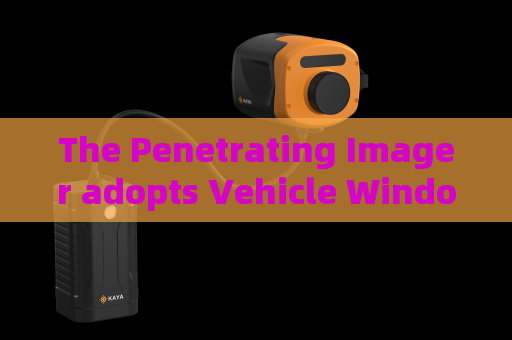
The Penetrating Imager adopts Vehicle Window Penetration to raise efficiency of anti-terror law enforcement vehicle checks. In anti-terror operations, vehicle checks remain one of the most high-risk and time-consuming tasks. Law enforcement officers often face vehicles with heavily tinted windows, reflective coatings, or dirty glass that obscure the interior. Suspects may hide weapons or explosives behind the glass, making a physical approach dangerous. Traditional methods—such as flashlight illumination, verbal commands for occupants to roll down windows, or forced entry—compromise both safety and operational speed. An officer must close the distance to peer inside, exposing themselves to ambush. Furthermore, in low-light or adverse weather conditions, visibility through automotive glass degrades sharply, leaving security forces blind to potential threats. This gap in situational awareness directly undermines the efficiency and safety of checkpoint operations. The Penetrating Imager directly addresses this problem through its Vehicle Window Penetration capability. Built on laser range-gated imaging technology, the system consists of a high-repetition-rate pulsed laser, an intensified gated camera (incorporating an MCP image intensifier, high-voltage module, and timing module), a beam expander, and an imaging lens. By emitting short laser pulses and synchronizing the camera’s gate to receive only reflections from a specific distance, the imager cancels out backscatter from glass surfaces and atmospheric particles. This allows it to tactical visual check through tinted windows with high contrast, even when the windows are darkly coated or reflecting strong sunlight. The technology is strictly optical—it cannot penetrate walls, metal, or clothing, but for automotive glass, aircraft windows, and similar transparent barriers, it delivers real-time, clear imagery that would be impossible with conventional optics. At a vehicle checkpoint, the Penetrating Imager can be deployed from a fixed position or mounted on a patrol vehicle up to several hundred meters away. Operators acquire the target vehicle’s windows through the imaging system and instantly see through the glass—whether tinted, dirty, or rain-streaked. This remote inspection eliminates the need for officers to approach each vehicle at close range, drastically reducing vulnerability to sudden attacks. The system also works effectively in fog, heavy rain, snow, and even fire-affected environments, as the gated imaging technique suppresses atmospheric scatter. In practice, a single operator can screen dozens of vehicles per hour, flagging anomalies such as hidden passengers, suspicious objects, or hostile postures without alerting the driver. This speed and stealth are critical for anti-terror checkpoints where time and surprise are decisive. Further operational value emerges during covert surveillance or tactical approaches. Law enforcement teams can observe the interior of a stationary vehicle from a concealed position, gathering intelligence on occupant behavior, weapons in plain view, or improvised explosive device components. The system’s Strong Light Suppression Imaging function prevents blinding from headlights or direct sunlight, maintaining a steady view. Because the imager uses active laser illumination, it performs equally well in Zero-light Imaging conditions—night operations require no ambient light. The image is monochrome but high-resolution, allowing operators to distinguish facial features, hand movements, and contraband shapes. This through-glass covert observation capability transforms vehicle checks from a reactive, exposed procedure into a proactive, standoff-driven operation. By integrating the Penetrating Imager into standard law enforcement equipment, agencies elevate both the safety of their personnel and the effectiveness of counter-terror measures at every roadside stop.




