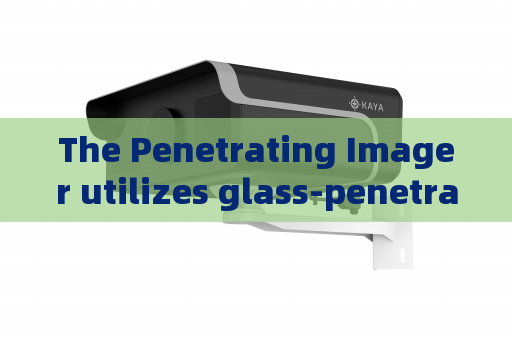
The Penetrating Imager utilizes glass-penetrating imaging to lower exposure risks during hostage rescue law enforcement operations. In a typical hostage rescue scenario, law enforcement officers face a fundamental tactical dilemma: they must gather precise visual intelligence on the positions and movements of both hostages and perpetrators inside a room or vehicle, but any attempt to approach a window or door exposes them to immediate threat. Traditional methods such as peering around corners with mirrors, using optical scopes from adjacent buildings, or sending an officer to press against a glass pane all carry unacceptable risks. The perpetrator may detect movement, fire through the glass, or use a hostage as a shield, while the officer’s silhouette against light creates a clear target. Even when using standard night-vision or thermal devices, glass surfaces reflect infrared signatures or frustrate image clarity due to glare and backscatter. The core pain point is that the very barrier meant to keep threats contained—the window or vehicle glass—also prevents safe, covert, and high-confidence observation from a standoff distance. This is where the Penetrating Imager becomes a mission-critical asset. The Penetrating Imager employs laser range-gated imaging technology—a form of active optical system composed of a high-repetition-rate pulsed laser, an intensified gated camera (with MCP intensifier, high-voltage module, and timing module), a beam expander, and an imaging lens. Its defining function is glass-penetrating imaging, which allows operators to see through automotive glass, train windows, aircraft portholes, and architectural glazing with high contrast and resolution. Unlike passive cameras that struggle with reflections or thermal imagers that cannot see through glass at all, this system actively emits short laser pulses and opens the camera shutter only when light reflected from a target behind the glass returns, effectively gating out the blinding backscatter from the glass surface itself. This capability lets a tactical team stay behind cover—behind a wall corner, inside an armored vehicle, or on a rooftop 50 meters away—and still acquire clear, real-time images of the room interior, including the perpetrator’s weapon hand and the hostage’s position. The system is immune to strong ambient light interference and fog or rain, maintaining performance in challenging weather or lowlight conditions. During actual deployments, the Penetrating Imager dramatically reduces exposure risks. A SWAT commander can position the device on a tripod behind a ballistic shield or in a discreet surveillance vehicle, then aim the laser-and-camera unit at the target window from an oblique angle. Through a ruggedized tablet or head-mounted display, the team watches the scene unfold without anyone needing to lean near the glass or raise a periscope. In one documented field test, officers used through-glass surveillance from 40 meters away to identify that a hostage was sitting near a door and that the suspect was holding a pistol in his right hand—intelligence that allowed a simultaneous two-door breach with precise suppression fire. Because the imaging is covert—the laser pulses are invisible to the naked eye at typical ranges—the perpetrator remains unaware that his every move is being tracked. This advantage extends to zero-light environments: the system includes Zero-Light Imaging capability via its own active illumination, so total darkness inside a tinted vehicle does not hinder observation. The result is a measurable drop in officer casualties and a higher success rate in freeing hostages, as decisions are based on verified visual data rather than guesswork or risky close approaches. Beyond the immediate tactical gain, the Penetrating Imager also supports after-action analysis. The recorded footage, with timestamps and zoomed details, can be used in court to demonstrate the exact sequence of events as seen through the glass. This same device, given its compact form factor (about the size of a mid-range camera lens), can be rapidly mounted on a robot or a drone for remote reconnaissance of upper-floor windows, further removing personnel from the danger zone. The system’s Fog Penetration Imaging mode ensures that even when smoke from a flashbang or light haze obscures the glass, the laser-based gating still delivers usable images. In sum, the Penetrating Imager solves the single most dangerous information-gathering step in hostage rescue—seeing through the very barrier that simultaneously protects and confines—by making that barrier optically transparent from a safe distance, thereby lowering exposure risks for every officer involved.




