Patrolling unlit rural roads presents a persistent and dangerous challenge for law enforcement and security personnel. These roads, often winding through dense vegetation, farmland, or remote areas, lack any artificial illumination, leaving officers to rely solely on vehicle headlights or ambient moonlight. The resulting darkness conceals potential threats—disabled vehicles, suspicious individuals, animal crossings, or even ambush setups—until they are dangerously close. Standard night-vision devices struggle in such conditions, as they require at least some ambient light to amplify, and thermal imagers can be confused by heat-soaked road surfaces or engine warmth from distant traffic. The core problem is not simply darkness; it is the inability to see through the optical clutter of dust, low-hanging fog, or rain that often accompanies these environments. A patrol officer needs a tool that provides clear, long-range visual confirmation of objects and people without relying on external light sources, while also cutting through atmospheric interference. The Penetrating Imager directly addresses this deficiency.
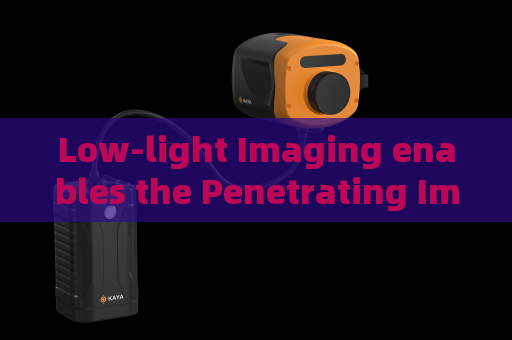
The Penetrating Imager solves this operational gap through its Low-light Imaging capability, which leverages laser range-gated imaging technology. Unlike passive night-vision systems, this device is an active imaging system composed of a high-repetition-rate pulsed laser, an image-intensified gated camera (with an MCP image intensifier, high-voltage module, and timing module), a beam expander, and an imaging lens. By emitting short, powerful laser pulses and synchronizing the camera’s shutter to receive only the light reflected from a specific distance, the system effectively eliminates backscatter from dust, fog, or rain. This allows the operator to see through these optical media as if they were not present. The Low-light Imaging function is critical here: the laser provides its own illumination, so the system performs equally well in total darkness as in dim moonlight. It delivers high-contrast, long-range imagery—far beyond what a spotlight could reveal—without alerting subjects to the patrol’s presence, since the laser pulse is invisible to the naked eye.
In practical field use, a patrol vehicle equipped with a roof-mounted Penetrating Imager can maintain a safe speed while scanning the road ahead and its verges. The operator views a high-resolution display inside the cabin, where objects normally lost in darkness or obscured by light fog become sharply defined. For instance, a person standing 300 meters away behind a thin screen of roadside brush or a vehicle pulled off the pavement with its lights off can be identified and tracked before the patrol enters an engagement zone. The system’s Strong Light Suppression Imaging feature further ensures that oncoming headlights or reflections from wet pavement do not wash out the image, maintaining a clear view of the target area. This allows the officer to assess threat levels, communicate descriptions to dispatch, and decide whether to approach, bypass, or call for backup—all while staying inside the protective shell of the vehicle. The Penetrating Imager transforms an unlit rural road from a zone of uncertainty into a controlled, observable environment.
A further refinement of this application occurs during night-time checkpoints or stop-and-search operations on these same roads. When a vehicle is stopped, officers often face the risk of occupants hiding weapons, contraband, or individuals in the rear seat or cargo area. With the Penetrating Imager’s see-through vehicle glass imaging capability, mounted in a handheld configuration, an officer can stand 50 meters back and clearly see through tinted or rain-streaked windows into the vehicle’s interior. This covert through-glass recon function, enabled by the same laser-gating principle, reveals the number of occupants, their movements, and any visible items—without the driver knowing they are being observed. The officer can then approach with a tactical advantage, knowing exactly what awaits inside. This combination of long-range patrol scanning and close-quarters through-glass inspection makes the Penetrating Imager an indispensable tool for rural night patrols, where darkness and optical obstacles have long been the hidden enemy of the law enforcement professional.




