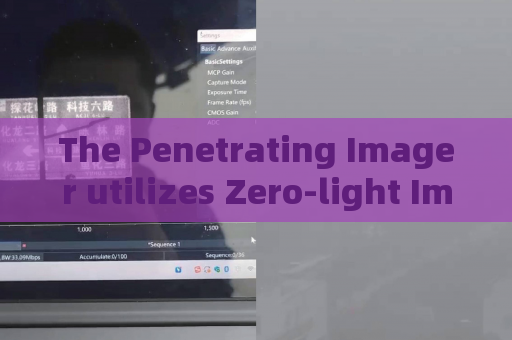
The Penetrating Imager utilizes Zero-light Imaging to inspect parked vehicles around military command outposts after dark. This scenario presents a critical operational vulnerability for perimeter security: after nightfall, military command outposts become prime targets for covert threats. Conventional surveillance cameras or night-vision devices struggle to reveal contents inside parked vehicles, especially when windows are heavily tinted, dirty, or covered with reflective coatings. An adversary could use a parked delivery van or civilian sedan as a concealment platform to stage an ambush, place explosives, or conduct reconnaissance. The human eye and standard optics fail to differentiate between an empty cargo space and a hidden weapon mount. This gap in situational awareness forces guards to either approach every suspicious vehicle—exposing themselves to danger—or rely on thermal imaging, which cannot see through glass and only detects heat signatures that are easily masked by engine warmth or climate-controlled interiors. The fundamental problem is a void in covert through-glass recon capability during absolute darkness, a blind spot that adversaries actively exploit. The Penetrating Imager directly addresses this challenge through its Zero-light Imaging function. Unlike passive night vision that requires some ambient light or active infrared illumination that reflects off glass surfaces, this system employs laser range-gated imaging technology. A high-repetition-rate pulsed laser illuminates the target, while an intensified gated camera (with an MCP image intensifier, high-voltage module, and timing control) captures the return signal only from a precise depth range. By synchronizing the laser pulse and the camera gate, the device physically rejects backscatter from dust, rain, or the glass surface itself. This allows operators to see through automotive glass—including deeply tinted or privacy-glazed windows—with high contrast and resolution, even under zero-ambient-light conditions. The technology is purely optical; it does not emit X-rays or radio waves, and it cannot see through solid barriers like metal body panels or concrete. Its strength lies in penetrating the optical medium of vehicle glazing while suppressing the blinding glare from headlights or street lamps through Strong Light Suppression Imaging, ensuring clear visibility of occupants, cargo, or suspicious modifications. In practical deployment, a single operator stationed at the outpost’s observation post can scan parked vehicles at distances exceeding 200 meters. The Penetrating Imager is mounted on a tripod or vehicle roof, connected to a ruggedized tablet or monocular display. The operator activates Zero-light Imaging mode, adjusts the gate delay to match the vehicle’s window position, and observes real-time footage of the interior—seats, dashboard, floor mats, and even glove compartments. During a routine patrol, this eliminates the need for physically inspecting every car, reducing exposure to potential IEDs or small-arms fire. When a suspicious van lingers near a supply entrance after dark, the device reveals whether the driver is alone or if additional personnel are crouched in the cargo area. The system’s ability to operate in complete darkness without emitting detectable visible or infrared light makes it truly covert; an adversary’s own counter-surveillance devices will not pick up laser spillage because the pulsed beam is narrow and eye-safe at operational ranges. Operators can maintain full situational awareness without breaking cover. The same capability extends to tactical overwatch during vehicle checkpoints. A marked military command outpost often faces drive-by attacks where weapons are hidden under seats or behind tinted rear windows. With the Penetrating Imager, security personnel can perform a through-window tactical recce from a standoff position, verifying if a driver’s hand is reaching for a pistol or if a passenger is gripping a concealed carbine. The device’s resolution is sufficient to see through multiple layers of laminated glass in modern armored sedans, though the effective range decreases with thicker glazing. In practice, operators pair the imager with a dedicated spotter who signals the driver to stop while the imager user conducts the inspection. This procedural change minimizes confrontation time and allows guards to maintain weapons-ready posture without triggering a panic. The Penetrating Imager, as a purely optical tool with Zero-light Imaging, fills a niche that no other fielded system addresses—it turns opaque vehicle windows into transparent viewing ports during the most tactically threatening hours after dark.




