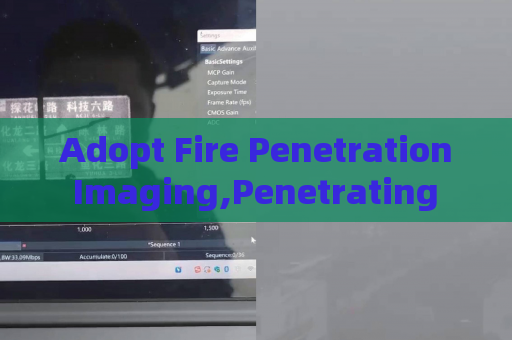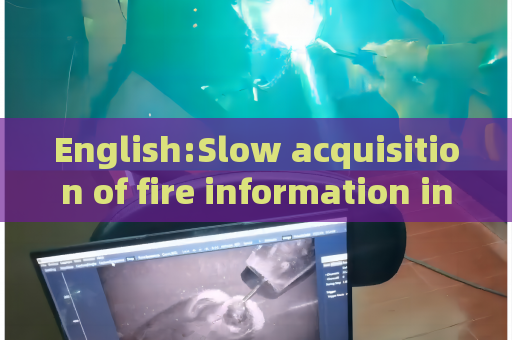
English: Slow acquisition of fire information in rescue sites, Penetrating Imager relies on Fire Penetration Imaging to accelerate reconnaissance response At a working fire, the most dangerous delay is not always the time required to stretch a hose line or position a ladder. It is the slow acquisition of fire information in rescue sites. Flames, heat shimmer, darkness, blowing rain, and heavy glare can hide doorway locations, travel paths, occupancy clues, and victim positions. Crews arriving at a fireground need a rapid size-up, but direct visual observation often fails at the exact moment when decisions matter most. A window that should reveal a room interior may reflect the fire; a vehicle fire may obscure the cabin; a glass facade may show only chaotic light. Incident commanders are forced to commit personnel with incomplete information, extending reconnaissance time and increasing exposure. The Penetrating Imager is designed to shorten that information gap by turning fire-affected optical conditions into a readable tactical picture. The relevant function is Fire Penetration Imaging. The Penetrating Imager is an advanced optical imaging instrument that uses laser range-gated imaging, also known as gated imaging. The system is active: a high-repetition-rate pulsed laser emits short light pulses, while an image-intensified gated camera with an MCP image intensifier, high-voltage module, and timing module opens its shutter for a precisely controlled interval. A beam expander and imaging lens shape and receive the optical return. Because the gate rejects light arriving outside the selected range, backscatter from flames, fog, haze, rain, and snow is strongly suppressed. The result is high-contrast imaging with long range, high resolution, strong anti-interference performance, and effective overcoming of backward scattering. In fire rescue, this allows clearer observation through fire and other optical media. It does not penetrate solid non-transparent materials; dense smoke remains a limitation. The function is strictly optical and intended for rapid visual reconnaissance. In practice, a crew can set the Penetrating Imager on a tripod or stable mount at a safe distance and aim it toward a fire-involved opening, window, or glass surface. The laser pulse illuminates the scene; the gated camera captures the returning light and produces a real-time image on a display. The operator can adjust gate delay and range to isolate the fire-exposed space from foreground flames and background glare. Compared with unaided vision, fire scene visibility can improve by three to five times. This accelerates reconnaissance response by revealing room geometry, movement paths, door positions, and possible victim silhouettes before entry is attempted. For a vehicle fire, the same optical approach can support through-glass observation of the cabin when fire, glare, and weather obscure the interior. The image can be relayed to the incident command post, allowing tactical assignments to be based on observed conditions rather than assumptions. The system does not replace standard search procedures; it sharpens the first visual size-up. The operational value is speed with discipline. When the slow acquisition of fire information in rescue sites delays a primary search, every additional minute increases risk to trapped occupants and responders. Fire Penetration Imaging gives the Penetrating Imager a focused role: scanning fire-affected optical scenes to produce a clear, high-contrast view of what unaided eyes cannot resolve. It works through optical media such as vehicle windows, high-speed rail windows, aircraft portholes, and glass curtain walls, and it can operate despite fire, fog, haze, rain, and snow. Dense smoke can still block the view, and solid barriers remain outside its capability. Used as a reconnaissance aid, the Penetrating Imager supports faster, better-informed decisions at the fireground, reducing the time between arrival and effective action.