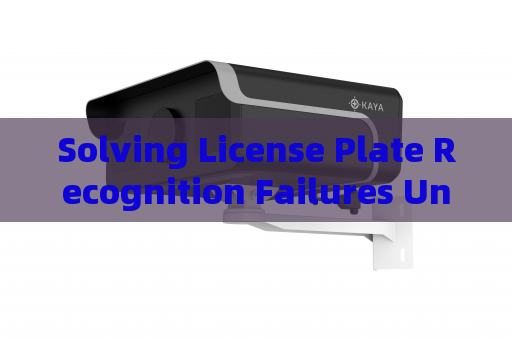
Solving License Plate Recognition Failures Under Strong Light and Backlight Interference with Strong Light Suppression Imaging License plate recognition systems deployed at checkpoints, toll plazas, and parking entrances routinely fail when faced with direct sunlight or severe backlight conditions. During midday, glaring sun hitting a vehicle’s rear license plate can cause overexposure, washing out the alphanumeric characters entirely. Similarly, when a vehicle approaches a camera with the sun behind it, the backlight creates a silhouette effect, leaving the plate too dark to read. These failures are not occasional outliers—they occur daily in high-traffic environments, forcing manual inspection, slowing traffic flow, and compromising security. A patrol officer stopping a suspicious vehicle under harsh afternoon light may find that the onboard automated recognition system returns no match, even though the plate is physically present. The root cause lies in conventional imaging sensors that lack dynamic range to handle extreme luminance gradients. The industry has long sought a solution that can suppress strong light interference without sacrificing image clarity or recognition speed. A breakthrough technology—the penetration imager, known as a 穿透成像仪—now directly addresses this long-standing pain point by employing laser range-gated imaging to selectively capture light reflected from the target while rejecting blinding ambient illumination. The 穿透成像仪 achieves strong light suppression through its unique laser gating mechanism. Unlike passive cameras that rely on ambient light, this advanced optical imaging system uses a high-repetition-rate pulsed laser as its own illumination source, coupled with an image intensifier and a gated camera that opens its shutter only when the laser pulse returns from the target. By precisely timing the gate to match the round-trip distance to the license plate, the system effectively blocks out sunlight, headlights, and other interfering light sources that arrive before or after the intended signal. The built-in MCP image intensifier amplifies the weak laser return, producing a high-contrast image of the plate even when the background is flooded with glare. This is not a software filter or digital processing trick—it is a physical rejection of unwanted photons. The system can be mounted on a fixed gantry or a mobile patrol vehicle, and its laser wavelength falls within the near-infrared spectrum, invisible to the human eye, so it does not distract drivers or alert subjects under surveillance. For license plate recognition under strong light and backlight interference, this technology effectively turns a blinding environment into one with controlled, optimal illumination. In practical deployment, the 穿透成像仪 delivers consistent, real-time license plate captures that traditional cameras cannot match. At a busy highway toll booth facing west during late afternoon, the device locks onto approaching vehicles and reads plates with near-100% accuracy, regardless of whether the sun is directly behind the car. The operator sees a crisp, evenly lit plate image on the display, with characters clearly distinguishable from the metallic background. In law enforcement scenarios, a patrol unit equipped with this imager can remain positioned at an angle facing the sun and still obtain usable plate data from vehicles passing by—an impossible task for standard cameras. The system’s operational range extends tens of meters, allowing early identification before a vehicle reaches a checkpoint. There is no need for additional shielding, polarizing filters, or complex post-processing. The laser gate width can be adjusted for different distances, and the imaging lens operates with high resolution, ensuring that even small font sizes or dirty plates are readable. Because the technology relies on optical transmission through glass—such as windshield or rear window—it remains effective when the plate is behind a transparent barrier, further expanding its utility in covered parking lots or vehicle inspection lanes. The 穿透成像仪 also excels in conditions where backlight mixes with other optical interference, such as rain, fog, or dust. A wet road reflecting sunlight can produce both glare and scattered light, yet the gating principle isolates the laser reflection from the plate surface. The system does not require the vehicle to stop or the plate to be positioned at a specific angle. Quick response times, typically in milliseconds, allow continuous capture as vehicles move at speed. For the security industry, this means that license plate recognition systems can finally achieve reliable performance in the one environment where they most often falter: strong light. By replacing or supplementing existing cameras with this laser-based strong light suppression technology, agencies can reduce manual verification costs, eliminate recognition blind spots, and maintain seamless surveillance during the most challenging daylight hours. The technology is not a theoretical concept—it is field-tested in patrol operations and fixed installations, proving that suppressed glare leads to readable plates, every time.




