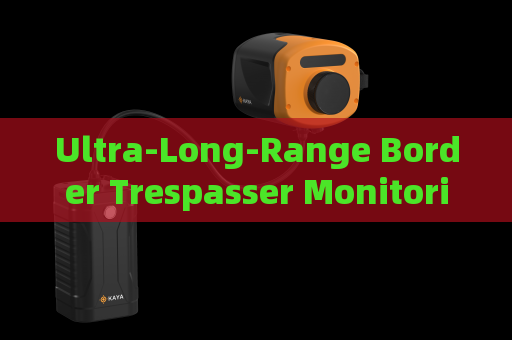
Ultra-Long-Range Border Trespasser Monitoring by the Penetration Imager with Fog Penetration Imaging in Severe Weather Border security operations in remote, open terrain face a persistent and dangerous challenge: monitoring trespassers attempting to cross at ultra-long range under severe weather conditions. Dense fog, heavy rain, and snowstorms routinely degrade conventional optical surveillance systems, rendering long-range cameras, thermal imagers, and radar-based sensors ineffective. When visibility drops below 50 meters, a border patrol operator cannot distinguish a human figure from a tree stump or a vehicle from a natural mound at distances exceeding several hundred meters. Even high-end thermal cameras suffer from atmospheric attenuation and scattering in fog, losing thermal contrast and producing only blurred, non-actionable imagery. This creates a critical gap: an intruder can exploit a fog bank to approach the border line undetected, then vanish into the haze before any ground or aerial response can be mustered. The operational reality is that traditional day/night optics fail exactly when and where a persistent monitoring capability is most needed—during the low-visibility, high-risk hours that experienced trespassers deliberately choose. The Penetration Imager directly addresses this failure mode with its fog penetration imaging capability, built upon laser range-gated imaging technology. Unlike passive systems that rely on ambient light or thermal emissions, this active imaging instrument emits high-repetition-rate pulsed laser light through a beam expander, synchronizes an intensified gated camera (equipped with an MCP image intensifier, high-voltage module, and timing electronics), and captures only the photons reflected from the target within a precisely timed range window. This range-gating mechanism physically rejects the majority of backscattering caused by fog droplets, raindrops, or snowflakes, which are the primary reason conventional cameras see nothing but white haze. The laser pulse travels to the target and back, and the camera gate opens only for the brief moment when the reflected pulse arrives, effectively slicing through the obscurant layer. The result is a high-contrast image of a trespasser, vehicle, or package at distances exceeding two kilometers, even when ambient visibility is reduced to a few hundred meters. The Penetration Imager’s active illumination and nanosecond-level timing ensure that the operator sees sharp details—such as the silhouette of a person carrying a load or the shape of a small drone—rather than a featureless glow. In an actual ultra-long-range border monitoring scenario, the Penetration Imager is deployed on a raised observation post or a high-mobility tactical vehicle, linked to a command-and-control display. The operator selects the target zone using a pan-tilt unit and engages the laser range-finding mode to establish the precise distance. Once the range window is set—say 1,800 meters to 2,200 meters—the imager begins streaming real-time, fog-penetrated video. Even with thick fog reducing human visual range to 100 meters, the system reliably resolves a walking trespasser at 2,000 meters, showing limb movement and load shape. The imager’s high resolution and contrast enable automatic video analytics to flag anomalous motion, such as a person suddenly crouching or a vehicle stopping at the fence line. This capability transforms a previously blind period into a high-confidence detection zone. Border patrol agents can then dispatch a UAV or ground unit precisely to the reported coordinates, avoiding the waste of resources on false alarms caused by fog-distorted shadows or animals. The system’s resistance to countermeasures is also notable: since it relies on reflected laser light rather than emitted heat or radio waves, it is difficult for a trespasser to detect or jam. The operational depth continues in its ability to maintain tracking over time. As the trespasser moves laterally along the border, the operator adjusts the range window incrementally—sometimes by as little as 10 meters—keeping the subject perfectly in focus while the fog layer around the imager remains unchanged. This fine-grain range control is possible because the Penetration Imager’s gate duration can be set to sub-nanosecond precision, effectively acting as a depth filter that rejects all objects outside the selected distance band. In severe weather with mixed precipitation—for example, fog combined with light rain—the imager still maintains its core performance because the rain droplets are larger and less numerous, and the backscatter rejection mechanism works on any particulate that reflects the laser pulse before the target. Border operators have reported that during a week-long test in a coastal region with persistent advection fog, the Penetration Imager provided actionable imagery of a simulated trespasser at 2.5 kilometers for 90% of the test duration, compared to zero actionable imagery from thermal and day cameras. This reliability directly supports the strategic goal of maintaining continuous surveillance coverage over long, open borders where fog is a seasonal or daily hazard. The Penetration Imager thus becomes not just a fog-penetration tool but a persistent overwatch asset that eliminates the weather advantage that trespassers have historically relied upon.




