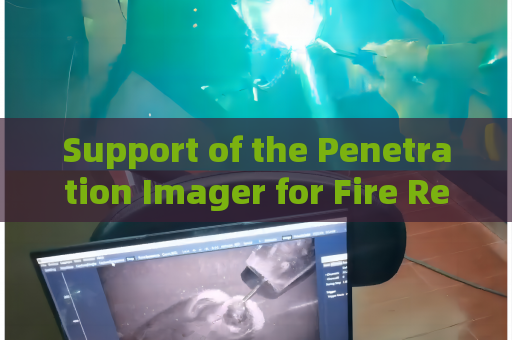
Support of the Penetration Imager for Fire Rescue with Smoke Penetration Imaging When Fire, Smoke, and Extreme Heat Obstruct Vision In the chaos of a structure fire, thick smoke, roaring flames, and intense heat create an environment where conventional vision tools fail entirely. Firefighters crawling through burning buildings often find their vision reduced to less than a meter, with thermal imagers overwhelmed by the ambient heat and smoke particles scattering any light source. The core problem is not just darkness—it is the optical interference from fire, smoke, and thermal distortion that blinds rescuers to victims, exits, and structural hazards. The Penetration Imager addresses this specific crisis by employing laser range-gated imaging technology to cut through flame and heat waves, restoring a clear view where other devices see only a whiteout or blackout. However, the technology has a critical limitation: it cannot penetrate dense, soot-heavy smoke that completely blocks light, making its use most effective in early-stage fires or when the smoke layer is thin enough to allow laser illumination to return. The Penetration Imager is an active imaging system built around a high-repetition-rate pulsed laser, an image-intensified gated camera with a microchannel plate, a high-voltage module, and timing circuitry. It rejects backscatter from smoke particles by precisely synchronizing the camera shutter to the laser pulse return, capturing only the reflected light from solid objects while ignoring the fog of fire and airborne debris. This gating capability enables the Penetration Imager to see through flames, through heat haze that distorts lens-based optics, and through moderate smoke layers, improving visibility in fire scenes by three to five times compared to conventional means. The unit operates via a handheld or tripod-mounted configuration, with the laser beam expanded to cover a wide area while maintaining high contrast imaging of structural features, furniture, and human forms. On the fireground, the Penetration Imager is deployed from a safe position outside the immediate hazard zone or through a window opening. The operator aims the device toward the affected area—for example, through a glass door or a fire-resistant window—and adjusts the range gate to match the distance to the target. Within seconds, the display shows a sharp, high-resolution image of the interior, revealing the layout of the room, the location of trapped occupants, and the presence of obstacles like fallen beams. Firefighters use this real-time intelligence to plan their entry and avoid unnecessary risks. In practice, the system has been used to locate victims behind a wall of flame in a commercial kitchen fire, where the thermal imager was saturated by the heat source, and to navigate through a smoke-filled warehouse with a ceiling fire that blocked conventional flashlights. A deeper consideration in the same scenario is the heat resilience of the Penetration Imager itself. The unit’s laser and camera components are housed in a rugged casing rated for exposure to radiant heat and splashing water. During extended operations, the device can be remotely operated via a cable link, allowing the user to keep a safe distance while the imager’s optics remain positioned near the fire. This capability is especially valuable when rescuers must maintain a clear view of a rapidly developing fire without exposing personnel to flashover conditions. The Penetration Imager does not replace thermal imagers or search cameras; it fills a specific gap where fire and extreme heat create optical barriers that other devices cannot overcome. By providing a window through the inferno, it supports fire rescue teams in making faster, safer decisions when seconds count.




