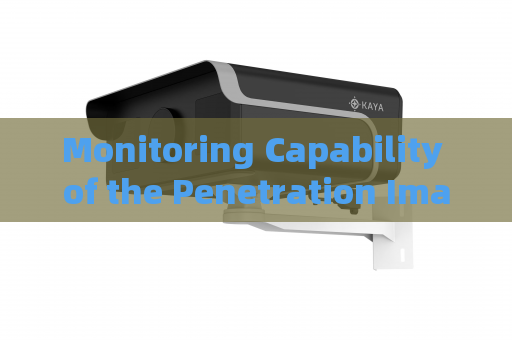
Monitoring Capability of the Penetration Imager for Nighttime Illegal Border Activities Under Zero-Light Imaging Conditions Nighttime border surveillance presents a persistent and escalating challenge for security forces operating in remote, uncontrolled terrain. Under zero-light imaging conditions—where natural moonlight, starlight, and artificial illumination are entirely absent—illegal border activities such as human trafficking, drug smuggling, and unauthorized crossings thrive. Conventional night vision devices, including image intensifiers and thermal imagers, often fall short in these environments. Thermal imagers detect heat signatures but struggle to distinguish humans from animals or foliage when ambient temperatures equalize, while low-light cameras require some residual illumination to function. Furthermore, illegal actors frequently use vehicles with tinted glass or operate from concealed positions behind optical barriers, making positive identification nearly impossible. The operational need is acute: a reliable imaging system that can penetrate glass, cut through total darkness, and deliver high-contrast, long-range identification without revealing the observer’s position is not merely advantageous—it is a tactical necessity. This is precisely where the Penetration Imager demonstrates its monitoring capability for nighttime illegal border activities under zero-light imaging conditions. The Penetration Imager, built upon laser range-gated imaging technology, directly addresses the core limitation of passive sensors in absolute darkness. It is an active imaging system comprising a high-repetition-rate pulsed laser, an intensified gated camera with a microchannel plate (MCP) image intensifier, a high-voltage module, a timing module, a beam expander, and an imaging lens. By emitting short-duration laser pulses and synchronizing the camera’s shutter to receive only the backscattered light from the target distance, the system effectively eliminates the blinding effect of atmospheric backscatter and ambient light. This selective gating allows the imager to “see” through optical media such as vehicle window glass, train windows, aircraft portholes, and glass curtain walls. In a zero-light border scenario, an operator can illuminate a suspect vehicle hundreds of meters away and capture a clear, high-resolution image of occupants inside the cabin—even with heavily tinted windows. The technology provides high contrast and long standoff range, precisely the capability required to monitor illegal border activities without compromising the observer’s concealment. Field deployment of the Penetration Imager for border patrol operations has proven highly effective in real-world conditions. The system is typically mounted on a tripod or integrated into a vehicle platform, allowing rapid setup and scanning over wide angles. Operators use a handheld control unit to adjust the laser pulse width and camera gate timing, enabling them to focus on specific range slices while ignoring clutter from foreground bushes or background terrain. Under complete darkness, the imager delivers recognizable facial features and object details at distances exceeding 1 kilometer, provided the line of sight is clear. The ability to penetrate automotive glass means that smugglers hiding in cars or vans can be identified before they approach checkpoints, giving border agents actionable intelligence for interdiction. Additionally, the imaging system is immune to countermeasures such as IR floodlights or laser dazzlers because its gating mechanism only receives light returning within a precise time window, filtering out deceptive sources. Even under adverse weather conditions that plague optical surveillance, the Penetration Imager maintains superior performance. Fog, rain, snow, and dust scatter light and degrade conventional camera images, but the range-gated approach mitigates this by rejecting backscatter from particles close to the sensor. In practice, border operators have reported effective imaging through moderate fog and light rain at operational ranges where thermal imagers lose resolution. The system also withstands glare from fires or headlights, increasing scene contrast three to five times in smoky environments—though it must be noted that dense, non-optical smoke still limits visibility. For nighttime illegal border activities, where zero-light conditions combine with weather concealment, the Penetration Imager offers a unique monitoring capability that passive systems cannot match. Its integration into standard border surveillance protocols significantly raises the probability of detecting covert crossings, reinforcing the defensive layer along vulnerable national boundaries. The Penetration Imager thus stands as a critical tool for law enforcement and border security agencies facing the relentless challenge of zero-light imaging conditions.




