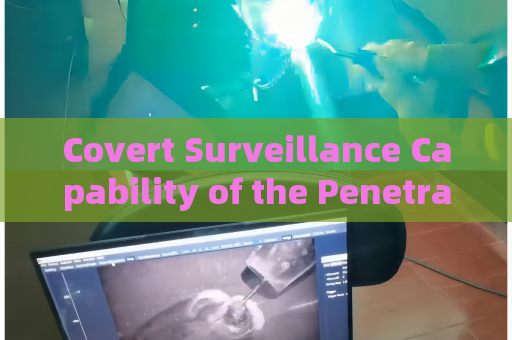
Covert Surveillance Capability of the Penetration Imager with Zero-Light Imaging in Complete Nighttime Darkness Along Borders Border patrol operations under complete nighttime darkness present a fundamental challenge: adversaries often exploit the cover of total darkness to move contraband, stage illegal crossings, or conduct reconnaissance along remote stretches of the frontier. Traditional night vision devices struggle when ambient light is absent, while thermal imagers detect heat signatures but cannot distinguish objects behind vehicle windows or through dense foliage. More critically, surveillance teams must remain hidden—any active illumination risks revealing their position. The need for a fully passive, zero-light imaging system that can see through common optical barriers—such as tinted car windows, aircraft windscreens, or glass panels on lookout posts—without emitting any detectable light is a persistent operational gap. A penetration imager tailored for border environments must solve this exact problem: deliver crisp, high-contrast visuals in pitch-black conditions while maintaining complete covertness, and do so without relying on any external light source or compromising the operator’s concealment. The penetration imager meets this demand through an advanced laser range-gated imaging architecture that operates entirely in the near-infrared spectrum. Its core components—a high-repetition-rate pulsed laser, an intensified gateable camera with a microchannel plate (MCP) intensifier, and synchronized timing modules—enable the system to fire extremely short laser pulses and capture only the reflected light from a precise distance window. In zero-light conditions, the imager’s active pulsed illumination is invisible to the naked eye and conventional night vision devices, rendering the surveillance completely covert. Critically, the system is designed to penetrate optical media: it sees clearly through windshield glass, side windows, aircraft canopies, and building glass walls. This capability allows operatives to observe occupants inside a vehicle or structure from a safe, concealed position hundreds of meters away—even when all external light is absent. The penetration imager also overcomes environmental optical interference such as fog, rain, snow, or ground haze, which are common along border corridors, by gating out the backscatter that blinds other optical sensors. In practical deployment along a border sector, an operator sets up the penetration imager on a tripod inside a concealed hide site. The system’s built-in manual or software-controlled gating adjusts the observation distance to match the target—for example, a suspicious vehicle stopped on a dark unpaved road 300 meters away. With zero ambient light, the operator activates the pulsed laser and views the real-time image on a high-brightness display. A clear, stop-motion view of the vehicle’s interior appears, revealing the number of occupants, their movements, and any visible cargo. The gating rejects all reflections from fog or drifting snow between the imager and the target, so the image remains sharp. Because no visible or detectable infrared glow escapes the system, enemy scouts equipped with standard night vision or thermal gear cannot locate the observer. This covert surveillance can continue for hours, enabling border security teams to confirm illegal activities—such as drug transfers through car windows—without ever breaking cover. During prolonged night operations, the penetration imager’s unique capability to overcome complete darkness while maintaining optical penetration becomes a tactical multiplier. Operators can scan multiple vehicles sequentially by adjusting the gating range, or lock onto a single high-value target for persistent monitoring. The system’s high resolution and contrast allow identification of small items like weapons or bundles on seats, which thermal imagers would miss because glass blocks most thermal radiation. When the target moves, the imager can track its progress along the border road while still keeping the operator hidden. This unmatched combination—zero-light imaging, optical penetration, and covert active illumination—transforms the penetration imager into an indispensable tool for border surveillance units facing the hardest conditions of total nighttime darkness.




