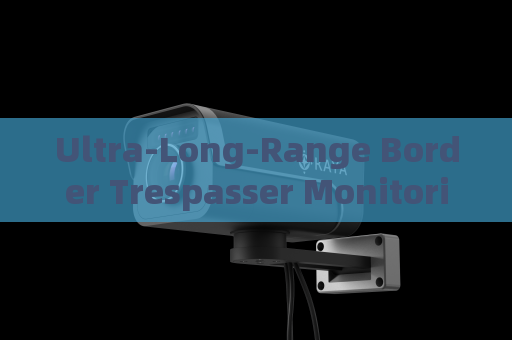
Ultra-Long-Range Border Trespasser Monitoring by the Penetration Imager with Fog Penetration Imaging in Severe Weather Border security faces a persistent challenge: monitoring vast, remote stretches of land where illegal border crossers exploit adverse weather to evade detection. In severe conditions such as dense fog, heavy rain, or thick haze, traditional optical surveillance systems—including long-range cameras and thermal imagers—suffer from severely degraded performance. Fog scatters visible light, reducing contrast and effective range to mere meters, while thermal sensors can be confounded by uniform temperature backgrounds and moisture absorption. This creates a critical blind spot: trespassers can approach border fences or cross open terrain under the cover of low visibility, and border patrol officers lack the ability to confirm a threat at safe standoff distances. The need for a solution that can see through these optical obscurants and deliver actionable intelligence at extreme ranges has become an operational priority for frontline agencies. The Penetration Imager addresses exactly this gap. The Penetration Imager employs laser range-gated imaging technology—an active optical system composed of a high-repetition-rate pulsed laser, an intensified gated camera (with MCP image intensifier, high-voltage module, and timing circuitry), a beam expander, and an imaging lens. Unlike passive sensors, it actively illuminates the target scene with short laser pulses and synchronizes the camera’s gating window to accept only the light returning from a specific distance slice. This time-of-flight gating mechanism effectively rejects backscatter from fog particles, raindrops, or aerosol haze, which would otherwise overwhelm the sensor. The result is high-contrast, long-range imagery even through dense fog that would blind conventional optics. Operating in the near-infrared spectrum, the Penetration Imager can penetrate optical media such as vehicle windows or aircraft canopies, but its core advantage in this scenario lies in its ability to cut through volumetric scattering in the atmosphere. For border applications, this means an operator can deploy the system on a fixed observation post, a mobile tower, or even a gimbal-mounted platform, and begin scanning a corridor several kilometers long despite zero visibility. In practice, a border patrol team sets up the Penetration Imager at a vantage point overlooking a high-risk crossing zone during a heavy fog event. The system is aimed toward the suspected approach route and the operator adjusts the range gate to match the distance of interest—for example, 3 kilometers out. The pulsed laser fires millions of times per second, and the gated camera captures only the light returning from that 50-meter depth slice, completely ignoring scattering from the fog between the system and the target. On the display, a clear image appears: human silhouettes moving through the brush, or even individuals lying prone to avoid detection. The operator can then track the trespassers in real time, confirm their intent, and relay coordinates to intercept units without ever closing to a dangerous visual distance. The system’s high frame rate and resolution allow it to distinguish between wildlife, civilian activity, and actual border violators, reducing false alarms. Operational testing has demonstrated that the Penetration Imager can maintain effective surveillance in fog that reduces visible-range camera performance to under 100 meters, extending usable detection distances to over 5 kilometers for a human-sized target. Further refinements in deployment include integrating the Penetration Imager with automated pan-tilt units for wide-area scanning and with video analytics that flag motion in the gated imagery. In persistent fog that lasts for days—common in coastal or mountainous border regions—the system provides continuous coverage where no other optical tool can function. It does not rely on ambient light or thermal signatures, making it equally effective at night or during midday haze. The operator’s workflow remains straightforward: select the range band, focus on the area of interest, and read the scene. Because the Penetration Imager only requires clear lines of sight to the target zone and no physical contact, it can be positioned behind protective glass or within a shelter without performance loss. This rugged reliability in severe weather ensures that border security agencies no longer lose situational awareness when the fog rolls in—they hold the tactical advantage, able to see trespassers long before those trespassers see them.




