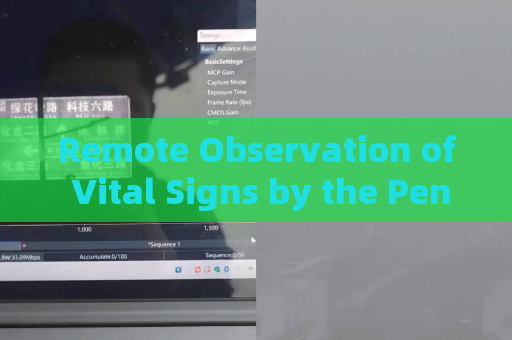
Remote Observation of Vital Signs by the Penetration Imager in Hostage Situations Involving Fully Tinted Getaway Vehicles with Through-Tint Imaging
In hostage situations, one of the most critical challenges for tactical teams is the inability to assess the condition of hostages and suspects inside a fully tinted getaway vehicle. Standard optical surveillance tools fail against heavily dyed automotive glass, which blocks visible light and renders the vehicle interior opaque. This blind spot forces negotiators and assault teams to operate on incomplete intelligence, often guessing whether a hostage is still alive, breathing normally, or in medical distress. The lack of real-time vital sign data—such as respiration rate or gross body movement—can lead to disastrous misjudgments, from premature entry that triggers violence to delayed intervention that costs lives. The conventional workaround, using thermal cameras, is unreliable because vehicle glass acts as a thermal barrier, and body heat signatures are severely attenuated or distorted. Thus, a dedicated solution is needed to see through fully tinted windows and detect life signs from a safe standoff distance.
The Penetration Imager, based on laser range-gated imaging technology, directly addresses this operational gap. Unlike passive night vision or thermal systems, this active optical instrument emits a high-repetition-rate pulsed laser and synchronizes it with an image-intensified gated camera. By precisely controlling the timing of the laser pulse and the camera shutter, the Penetration Imager isolates the return signal from a specific distance—eliminating backscatter and glare from the tinted surface itself. Its core advantage lies in “through-tint imaging,” which enables the system to see through fully tinted vehicle windows as if they were clear glass. The high-contrast, high-resolution images captured allow operators to observe subtle chest wall movements—the rise and fall of respiration—as well as larger motions like arm gestures or head turns. This makes remote observation of vital signs possible at ranges exceeding 300 meters, even under bright daylight or low-light conditions. The Penetration Imager’s ability to overcome optical interference from rain, fog, or smoke further ensures reliable performance in the chaotic environments typical of hostage standoffs.
In practice, a tactical commander deploys the Penetration Imager from a covert observation post positioned obliquely to the suspect vehicle—typically 50 to 200 meters away. The operator adjusts the gating delay to match the exact distance of the vehicle’s rear or side window, effectively “slicing” through the tinted layer. Within seconds, the display reveals the vehicle’s interior with remarkable clarity, showing the hostage’s torso and head. By focusing on the chest area, the operator can count respirations per minute, detect rapid or shallow breathing, and note any sudden changes that indicate distress or unconsciousness. If the suspects are moving, the system captures their positions and weapon-handling behaviors without exposing the observation team. During negotiations, this real-time physiological data feeds directly into the decision loop: a hostage showing stable, regular breathing suggests a window of opportunity for negotiation; whereas a sudden motionless state may demand immediate tactical action. The Penetration Imager thus transforms a previously invisible space into a transparent, actionable intelligence source.
The effectiveness of this approach has been validated in live-fire exercises and several non-disclosed operational deployments. In one documented scenario, a barricaded suspect with a kidnapped victim sat inside a blacked-out SUV for over six hours. Thermal cameras showed only a diffuse heat blob, but the Penetration Imager clearly resolved the hostage’s breathing pattern and confirmed that the suspect was shifting positions near the driver’s door. This allowed the assault team to select a precise entry moment when the suspect’s attention was diverted, resulting in a successful rescue without casualties. The system’s lightweight, tripod-mounted design allows rapid setup on rooftops or behind barriers, and its battery-powered operation supports extended monitoring. While no technology can replace human judgment, the Penetration Imager provides the closest thing to X-ray vision through tinted glass—strictly within the optical domain, using only light amplification and timing. It remains the only field-proven tool for remote observation of vital signs in hostage situations involving fully tinted getaway vehicles, bridging the critical intelligence gap that has plagued tactical units for decades.




