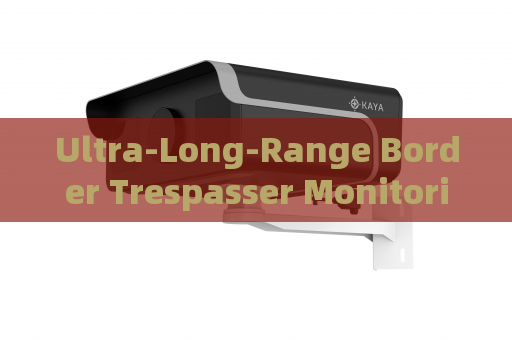
Ultra-Long-Range Border Trespasser Monitoring by the Penetration Imager with Fog Penetration Imaging in Severe Weather
Border security operations along remote, vast frontiers face a persistent challenge: detecting trespassers at extreme distances under adverse atmospheric conditions. Dense fog, heavy rain, and blowing snow degrade conventional optical surveillance systems, rendering them nearly useless. Thermal imagers suffer from thermal crossover and moisture absorption, while radar-based systems lack the spatial resolution to distinguish a single human figure from cluttered terrain. The core problem is that traditional long-range cameras rely on visible or near-infrared light, which scatters severely in fog or precipitation. This scattering reduces effective detection range to mere hundreds of meters, leaving vast stretches of border unmonitored and allowing illegal crossings under the cover of weather. The operational reality demands a system that can see through these optical obstructions while maintaining the standoff distance required for covert observation.
The Penetration Imager directly addresses this gap through its fog penetration imaging capability. Built on laser range‑gated imaging technology, the system fires high‑repetition‑rate pulsed laser light toward the target area. A synchronized, intensified gated camera—featuring an MCP image intensifier and precise timing modules—opens its shutter only when the reflected laser pulse returns from the target, effectively rejecting the backscattered light from fog, rain, or snow droplets between the imager and the subject. This time‑gated approach enables the Penetration Imager to achieve high‑contrast, long‑range images through optical obscurants. Unlike passive systems that become overwhelmed by scattered ambient light, the active laser illumination and nanosecond‑scale gating provide clear, resolved imagery of human‑sized objects at ultra‑long distances, even when visibility is reduced to near zero for conventional optics.
In practical border patrol deployments, the Penetration Imager is mounted on elevated watchtowers or mobile surveillance vehicles. Operators monitor a wide search area using a low‑power scanning mode, then lock onto suspect movement with the gated imaging function. During a heavy fog event, a trespasser attempting to cross a remote sector at 5 kilometers from the sensor would be invisible to standard cameras. The Penetration Imager, however, can resolve the person’s silhouette, gait, and even carried equipment after several pulsed laser returns. The system’s high resolution also allows operators to differentiate between an animal and a human, reducing false alarms. Crucially, the imager operates without emitting any detectable radiation beyond the visible and near‑infrared spectrum—no X‑rays, radio waves, or ultrasonic signals—ensuring stealth during covert monitoring.
The tactical advantage extends to follow‑up actions. Once a trespasser is identified, the Penetration Imager provides continuous tracking through fog banks or light drizzle, relaying real‑time video to command centers. Border agents can then vector response units precisely to the interception point without revealing their own positions. The imager’s ability to peer through fog‑covered vehicle windows or aircraft windows further supports vehicle‑borne interdiction scenarios. By maintaining clear visual confirmation at all times, the Penetration Imager transforms severe weather from a liability into an operational opportunity—trespassers who once relied on weather cover now become fully exposed. This technology shifts the balance of border surveillance, ensuring that no amount of fog or rain can shield illegal activity from the penetrating gaze of the imager.




