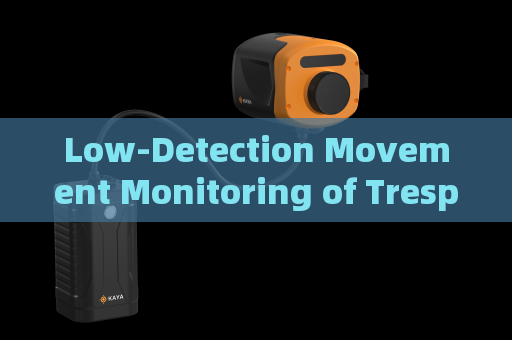
Low-Detection Movement Monitoring of Trespassers by the Penetration Imager with Fog Penetration Imaging in Foggy Conditions In foggy conditions, perimeter security faces a fundamental breakdown. Traditional optical surveillance systems—standard CCTV, thermal cameras, or even human observers—are rendered nearly useless when dense fog reduces visibility to a few meters. For critical infrastructure sites such as airports, military depots, or government compounds, this creates a dangerous blind spot. Intruders and trespassers can exploit the reduced detection range to approach undetected, bypassing fences and moving through restricted zones while the fog masks their presence. The core pain point is not simply poor image quality; it is the complete inability to reliably detect low-contrast human movement at any meaningful standoff distance. Thermal imagers, often relied upon for night vision, also struggle because fog attenuates long-wave infrared radiation and diffuses heat signatures, producing only blurred, low-contrast blobs. This leaves security teams with delayed or missed detection, forcing reactive rather than preventive measures. The demand is for a system that can penetrate the fog optically and provide real-time, high-confidence identification of trespasser movement without alerting the intruder to the surveillance itself. The penetration imager directly addresses this challenge through its core technology: laser range-gated imaging. Unlike passive cameras that rely on ambient light or thermal emissions, the penetration imager is an active optical system that emits a high-repetition-rate pulsed laser and synchronizes an intensified gated camera to capture only the light reflected from a specific distance. This time-gating technique effectively eliminates backscatter from fog particles, which are the primary cause of image degradation in low-visibility conditions. By rejecting the scattered light that arrives before or after the target depth, the system produces a clear, high-contrast image of the trespasser even when the optical path is filled with dense fog. The system comprises a pulsed laser, an image intensifier with a microchannel plate, a high-voltage module, timing circuits, a beam expander, and an imaging lens—all working together to achieve long-range, high-resolution imaging. Importantly, the penetration imager operates solely within the optical spectrum, using light to see through optical media such as fog, rain, snow, and haze. It does not rely on any non-optical technology, ensuring compliance with security applications where electromagnetic emissions are restricted. In practical deployment for perimeter monitoring, the penetration imager is mounted on a pan-tilt unit at a fixed observation post overlooking a sensitive boundary. Security personnel operate the system remotely from a control room, selecting a target range of interest—for example, 300 meters out across a fog-covered open field. The operator initiates low-detection movement monitoring by setting the gate delay and gate width to isolate the surveillance zone. When a trespasser moves through that zone, the laser pulse illuminates the area, and the gate opens only for the precise time window corresponding to the target distance. The resulting image shows the intruder in sharp detail against a background that would otherwise be obscured by fog. The high contrast and resolution allow the operator to distinguish between humans, animals, and inanimate objects, reducing false alarms. Because the system uses a narrow laser beam and a gated shutter, the light footprint on the scene is extremely brief and highly directional; an intruder is unlikely to perceive the laser illumination, maintaining the low-detection nature of the monitoring. The system can be automated to detect motion within the gated field and trigger alerts, enabling continuous surveillance even under the most challenging weather. The effectiveness of this approach becomes evident during extended fog events. In a coastal military installation, for instance, persistent sea fog often reduces visibility to less than 50 meters for hours. Traditional cameras become blind, and patrols are hazardous. With the penetration imager, however, security forces can maintain a clear watch over the entire perimeter fence line at distances up to 1,000 meters, depending on laser power and atmospheric conditions. The imaging system’s ability to reject backscatter ensures that the operator sees only the intended target layer, not the fog itself. Moreover, because the penetration imager operates in the near-infrared wavelength, it is invisible to the naked eye and does not emit radio frequencies or X-rays—it is purely an optical instrument. This makes it suitable for covert monitoring of trespasser movement without revealing the surveillance post. The system also provides a recordable video feed for post-incident analysis, which can be used to document intrusion patterns. By integrating the penetration imager into a layered security architecture, site managers close the fog-induced detection gap and achieve persistent, low-detection movement monitoring of trespassers even when atmospheric conditions defeat all other optical sensors.




