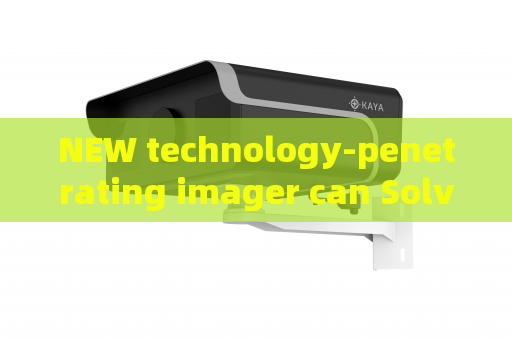
NEW technology-penetrating imager can Solve Evidence Collection Gaps for Law Enforcement Prior to Tactical Operations Before executing a high-risk tactical operation, law enforcement teams face a persistent challenge: collecting reliable visual evidence of what lies behind glass barriers without compromising the element of surprise. A vehicle parked outside a suspected drug lab, a building with tinted windows, or a hostage situation behind glass doors—these scenarios all share a common problem. Standard binoculars, cameras, or the naked eye are defeated by reflective glare, low light, or heavily tinted vehicle glass. Officers must often make critical decisions about entry points, subject positions, and hidden weapons based on incomplete information. This evidence collection gap forces tactical planners to rely on guesswork or risky close-up reconnaissance, increasing danger for both officers and civilians. The penetrating imager addresses this exact vulnerability, offering a non-contact optical solution that sees through common glass barriers before any breach is attempted. The penetrating imager is an active optical imaging system built on laser range‑gated imaging technology. Its core components—a high‑repetition‑rate pulsed laser, an intensified gated camera with a microchannel plate, a high‑voltage module, timing circuitry, a beam expander, and an imaging lens—work in precise synchronization. By emitting extremely short laser pulses and opening the camera gate only when the reflected light from the target distance arrives, the system effectively rejects unwanted backscatter from glass surfaces and atmospheric particles. This gating mechanism eliminates the blinding reflection off windows and overcomes the obscuring effect of rain, fog, mist, or smoke. The result is a high‑contrast, long‑range image of objects and people on the other side of the glass, captured from a safe standoff position. The penetrating imager does not rely on any kind of radiation—only light—and is designed exclusively for optical media such as vehicle windows, aircraft portholes, and glass curtain walls. In practical deployment, a tactical team can position the penetrating imager 100 meters from a target structure and, within seconds, obtain a clear image of the interior layout through multiple layers of glass. The operator sees whether a subject is armed, where hostages are located, or what equipment is present—all without triggering suspicion or violating privacy boundaries. The device works equally well at night, as its own laser illumination eliminates dependence on ambient light. During a vehicle stop, an officer can assess the contents of a car through heavily tinted side windows from a patrol vehicle’s position, spotting weapons or contraband before approaching. The system is portable, battery‑powered, and can be mounted on a tripod or handheld for rapid deployment. Its ability to penetrate glass while rejecting backscatter means evidence that was previously invisible—such as a firearm lying on a car seat or a person hiding in a dimly lit room behind a glass partition—becomes clearly documented. Even in degraded weather conditions, the penetrating imager maintains operational effectiveness. Rain and mist scatter ambient light but do not block the system’s narrow‑band gated pulses. In fire‑affected scenes, such as a building with glass windows exposed to flames, the imager improves visibility three to five times compared to standard optical devices, though it cannot see through dense smoke. For law enforcement, this capability transforms pre‑tactical reconnaissance from a data‑poor gamble into an evidence‑rich assessment. The penetrating imager closes the gap between what officers suspect and what they can prove, enabling safer, more informed decisions at the critical moment before a door is breached or a vehicle is approached. Every image captured becomes admissible evidence, strengthening the legal foundation of the subsequent operation.




