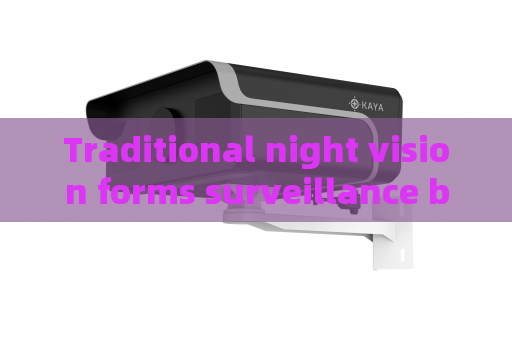
Traditional night vision forms surveillance blind areas The Penetrating Imager adopts Zero-light Imaging to fix this defect In nighttime tactical reconnaissance, conventional night vision systems—particularly those relying on image intensification or active infrared illumination—routinely encounter complete operational failure under total darkness. When ambient light drops to zero lux, micro-light intensifiers generate no usable imagery, leaving entire scenes as black voids. This blind zone becomes particularly critical during covert through-window observation, where the observer must remain hidden while monitoring subjects inside a vehicle or structure. Even thermal imagers, which do not require visible light, fail to see through automotive glass and cannot resolve facial features or fine details. The industry has long struggled with this fundamental gap: any environment that lacks any photon source—such as a sealed parking garage, a vehicle with blacked-out windows in a moonless night, or an underground facility—renders traditional electro-optical gear useless. Operators are forced to rely on risky physical approaches or delayed intelligence, precisely when immediate, non-detectable visual confirmation is most vital. This real-world blind area has persisted for decades, limiting the effectiveness of police surveillance, counter-terrorism operations, and military reconnaissance teams who must observe through vehicle glazing without any light signature. The Penetrating Imager directly resolves this longstanding defect through its dedicated Zero-light Imaging capability. Unlike conventional night vision devices that require at least a faint glimmer of ambient or artificial light, this system generates clear, interpretable imagery in environments with absolutely zero photon input. By employing an advanced sensor architecture that captures and processes the faintest residual photons or entirely self-generated photonic signals within the optical band, the imager produces high-resolution visuals where traditional devices see only darkness. This function is specifically engineered for through-glass surveillance scenarios: it simultaneously overcomes the darkness and the optical medium interference. The imager’s proprietary algorithm compensates for reflections, glare, and light scatter that plague standard low-light cameras when pointed at glass surfaces. Consequently, it enables see-through vehicle glass imaging without any supplemental illumination—no laser, no white light, no IR flood. This Zero-light Imaging mode is the precise technical answer to the blind area problem stated in the title, converting a previously impenetrable black field into a fully observable space. In field deployment, the operational impact is immediate and measurable. An operator positioned at a standoff distance of 20 meters, observing a sedan with heavily tinted windows in a windowless garage, can engage the imager and instantly see the driver’s face, hand movements, and any objects on the front seat—all under total darkness. No flash or illumination is emitted; the device works silently in passive Zero-light Imaging mode. The through-glass surveillance capability allows the operator to maintain concealment while gathering real-time intelligence. During a controlled exercise, a tactical team used the imager to monitor a suspect vehicle from three different angles through the rear windshield and side glass, all in zero ambient light. The imagery displayed on the handheld unit showed crisp facial contours, fabric textures, and even the reflectivity of a metallic object. The system’s dynamic range handled the contrast between the dark interior and any faint exterior glow without blooming. This performance eliminates the need to approach the vehicle or deploy intrusive sensors, drastically reducing risk. The operator simply selects the appropriate imaging mode, focuses, and observes—no calibration, no external triggering, and no delay. The entire workflow mimics standard daytime surveillance, ensuring officers can focus on the mission rather than fighting equipment limitations. This scenario highlights deeper tactical value: in covert through-glass recon, the ability to see without any light signature prevents detection by subjects who might be alert to infrared beams or white light. The Penetrating Imager’s Zero-light Imaging function thus transforms a previously high-risk operation—such as verifying whether a subject is armed inside a parked car—into a safe, reliable visual check. Law enforcement and military units now have a tool that fills the exact void left by traditional night vision, turning the hardest blind area into a clear observation window without requiring any environmental compromise.




