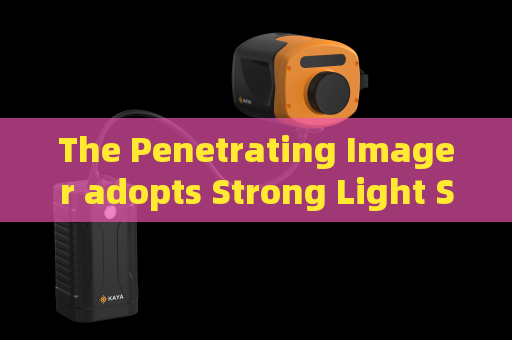
The Penetrating Imager adopts Strong Light Suppression Imaging to maintain sharp pictures under oncoming headlight light
The most deceptive threat in nighttime vehicular operations is not darkness but blinding light. When a patrol car or tactical surveillance unit attempts to observe a target vehicle approaching from the opposite direction, the intense beam of oncoming headlights floods the optical sensor, washing out every detail behind that glare. The officer behind the camera sees nothing but a white wall of light—no license plate, no driver’s face, no potential weapon in the passenger’s hand. This is not merely an inconvenience; it is a critical vulnerability. In high-stakes scenarios such as traffic interdiction, border checkpoint monitoring, or covert observation of a suspect vehicle, the loss of visual intelligence during that split-second glare can mean the difference between a safe resolution and a lethal escalation. Traditional image sensors lack the dynamic range to handle such extreme contrast, leaving law enforcement and security personnel effectively blind when they need clarity most.
The Penetrating Imager solves this fundamental problem by deploying Strong Light Suppression Imaging, a specialized function derived from its core laser range-gated architecture. Unlike conventional cameras that indiscriminately capture all incoming photons—including the overpowering headlight flux—this system synchronizes a pulsed laser illuminator with an ultrafast gated intensifier. The intensifier’s shutter opens only when the laser pulse reflected from the target scene returns to the sensor, precisely shuttering out any light that arrives before or after that gated window. Oncoming headlight beams, being continuous and uncorrelated with the laser pulse, are drastically attenuated. In effect, the device sees through the glare as if the headlights were dimmed to near-invisibility. The result is a crisp, high-contrast image of the vehicle interior, the occupant’s actions, and the surrounding road environment, all captured while the target is still hundreds of meters away—well before any confrontation begins.
In actual field deployment, this capability transforms the way officer-on-duty teams conduct through-window tactical recce. Mounted on a tripod or vehicle platform, the unit can be operated from a safe standoff distance. The operator monitors the display in real time, watching a suspect vehicle approach. As the headlights sweep across the scene, the image remains stable and detailed—no blooming, no washout. The plates are legible, the driver’s hand movements are visible, and any objects on the seat or in the rear compartment are distinguishable. This allows a tactical decision to be made without ever approaching the vehicle blindly. In border security operations, the same technology enables covert observation through automotive glass under harsh lighting conditions—whether the sun is low in the sky or a truck’s high beams are blasting directly into the lens. The effect is consistent: the glare disappears, and the operational picture remains intact.
The Penetrating Imager’s Strong Light Suppression Imaging further excels in environments where ambient light fluctuates unpredictably, such as highway patrol zones peppered with streetlamps, road flares, and passing traffic. Because the gating mechanism rejects all non-laser light, even rapid flickers from multiple headlights cannot break the image. The unit’s active laser ensures that the only light contributing to the picture is the one it controls—giving the user a reliable, repeatable visual feed that no other optical system can match. Each time a new set of headlights appears, the camera simply continues to gate out the interference, preserving the sharpness that conventional imagers lose instantly. For any agency that must identify threats hidden behind glare, The Penetrating Imager adopts Strong Light Suppression Imaging to maintain sharp pictures under oncoming headlight light—and that makes all the difference in the field.




