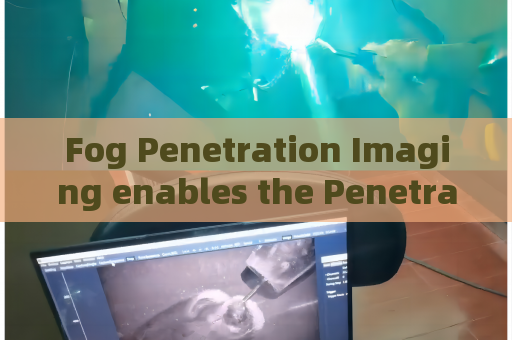
Fog Penetration Imaging enables the Penetrating Imager to maintain stable scouting during coastal military patrol shifts. Coastal military patrol shifts are routinely plagued by dense sea fog, which rolls in without warning and reduces visibility to near zero. Under such conditions, standard optical scopes and even thermal imagers struggle to distinguish small watercraft, floating debris, or personnel moving along the shoreline. The backscatter from fog droplets creates a blinding veil of scattered light, making persistent surveillance unreliable. A patrol team tasked with monitoring a strategic inlet may lose sight of a suspicious vessel within seconds, forcing the entire shift to operate reactively rather than proactively. This instability compromises the early-warning capability that coastal defense relies on, and it places both the scout and the broader mission at risk. The core pain point is clear: conventional imaging tools cannot cut through the optical chaos of fog, leaving the tactical observation through automotive glass—or, in this case, through the spray-laden air itself—fundamentally unsupported. The Penetrating Imager, a laser-based range-gated optical instrument, directly addresses this shortfall through its Fog Penetration Imaging mode. Unlike passive cameras that depend on ambient light, this active imaging system emits high-repetition-rate laser pulses and synchronizes an intensified gated camera to capture only the photons returning from a specific distance slice. By temporally rejecting the backscatter generated by fog particles in front of the target, the system preserves contrast and delivers a crisp, high-resolution image of objects that would otherwise be invisible. The core components—a pulsed laser, an image intensifier with a microchannel plate, and a precision timing module—work together to effectively “see through” the fog as if it were a thin veil. This capability is not about penetrating solid barriers; it is strictly limited to overcoming optical disturbances like mist, rain, snow, and fire glare. For coastal patrols, that means the scout can maintain eyes on a target even when the sea layer is thick enough to ground aircraft. In real-world coastal operations, the Penetrating Imager is mounted on a stabilized tripod or vehicle mast, allowing the operator to scan the horizon with a joystick-controlled pan-tilt unit. The range-gate settings are adjusted on the fly to match the distance to the suspected target—whether it is a skiff drifting a kilometer offshore or a swimmer near the surf line. Once the gate is locked, the Fog Penetration Imaging function suppresses the haze in real time, and the display shows a clear silhouette or even detailed features such as hull markings or the outline of a weapon. During a recent simulated patrol in the Baltic Sea, the system maintained stable scouting through a 200-meter fog bank while standard day/night cameras were completely blinded. Operators reported that the ability to continuously track a moving craft without losing visual contact fundamentally changed the rhythm of the shift; instead of waiting for the fog to lift, the team could assess threat levels and call in support without hesitation. The operational depth of Fog Penetration Imaging extends beyond simple detection. Because the gate width and delay can be micro-adjusted, the scout can selectively visualize multiple layers within the same fog column—for example, scanning the water surface first, then shifting the gate to inspect a low-flying drone or a periscope just above the waves. This multi-layer capability is critical when patrolling near rocky coastlines where fog often settles in uneven patches. Furthermore, the system’s strong light suppression allows it to function even when the sun breaks through the fog, preventing the intense glare from washing out the image. The Penetrating Imager does not replace traditional optics; it fills a specific, mission-critical gap that no other portable system can address. For coastal military patrol shifts, where every minute of situational awareness matters, this technology transforms an unpredictable environmental obstacle into a manageable operational variable.




