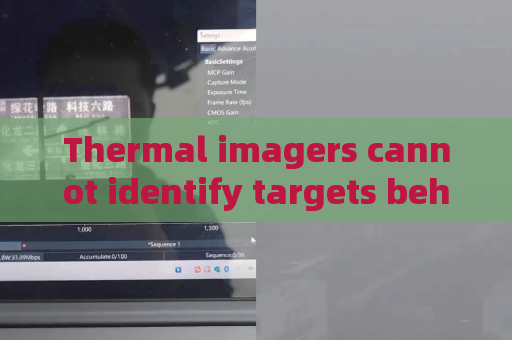
Thermal imagers cannot identify targets behind automotive glass The Penetrating Imager gains clear footage steadily In tactical reconnaissance and law enforcement operations, the inability to see through automotive glass remains a critical blind spot. Standard thermal imagers, widely used for detecting heat signatures, are fundamentally incapable of identifying targets positioned behind vehicle windows. Automotive glass—especially laminated windshields and tinted side windows—blocks the infrared radiation emitted by human bodies, rendering thermal sensors useless for through-glass observation. This limitation forces operators to either expose themselves by moving closer to a suspect vehicle or rely on risky visual checks. The result is a dangerous gap in situational awareness during vehicle stops, surveillance, or hostage situations, where knowing the number, position, or intent of occupants inside a car can mean the difference between life and death. The penetrating imager addresses this exact problem with a fundamentally different optical approach. The penetrating imager solves this issue by employing laser range-gated imaging technology, a form of active optical system that uses a high-repetition-rate pulsed laser paired with an intensified gated camera. Unlike passive thermal devices that depend on emitted heat, this system actively illuminates the target with short laser pulses and synchronizes the camera’s shutter to capture only light reflected from a specific distance, effectively “slicing” through the glass and rejecting backscatter. This enables clear, steady footage of objects and persons behind automotive glass, even when the windows are heavily tinted or coated. The technology is specifically designed for tactical observation through automotive glass—it can see through car windows, train windows, aircraft portholes, and glass facades without relying on temperature differences. The penetrating imager maintains high contrast and resolution, providing operators with real-time visual intelligence that thermal imagers simply cannot deliver. In practice, a penetrating imager can be deployed from a covert observation post or a moving surveillance vehicle to monitor a suspect’s car from a safe standoff distance. The operator aims the device at the vehicle’s windshield or side windows, and the system automatically gates the laser pulses to match the distance to the glass surface and the interior behind it. The resulting footage shows occupants, their movements, and any objects they are holding—all captured steadily through the glass barrier. This capability is especially valuable during high-risk traffic stops, where officers need to confirm whether a driver is reaching for a weapon, or in counter-surveillance operations requiring silent, non-contact intelligence gathering. The imaging remains effective in low-light and zero-light conditions, and the active laser illumination ensures consistent performance regardless of the ambient lighting. Operational deployments have confirmed that the penetrating imager eliminates the need for close-proximity visual checks, reducing officer exposure to ambush threats. Unlike thermal imagers that fail completely behind glass, the penetrating imager delivers actionable footage that can be transmitted to command centers for real-time decision-making. The system’s ability to compensate for environmental interference—such as fog, rain, or glare from headlights—further enhances its reliability during night-time vehicle interdictions. By providing a steady, clear view into a sealed vehicle, the penetrating imager transforms a previously opaque environment into a transparent tactical picture, directly addressing the core limitation stated in the title.




