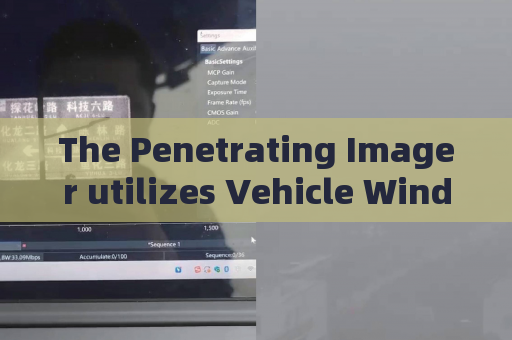
The Penetrating Imager utilizes Vehicle Window Penetration for covert military vehicle reconnaissance at border outposts. Border outposts face a persistent and critical challenge: conducting covert reconnaissance on vehicles approaching from hostile territory. Standard optical tools, such as binoculars or daytime cameras, are rendered almost useless by modern automotive glass—tinted, reflective, or layered with metallic coatings. These windows obscure the occupants, cargo, and potential threats inside a target vehicle. Even under favorable daylight conditions, glare and reflections create a mirror-like surface, preventing any visual assessment. At night or in low-visibility weather—fog, dust, or light rain—the problem compounds. Patrols cannot determine if a vehicle carries armed insurgents, smuggled contraband, or innocent civilians until it is dangerously close. The lack of a reliable, stand-off method for tactical observation through automotive glass forces operators into high-risk decisions or missed intelligence. The Penetrating Imager solves this operational gap through its core capability: Vehicle Window Penetration. This is not a hypothetical concept but a proven optical technique based on laser range-gated imaging. The system emits a high-repetition-rate pulsed laser that synchronizes with an intensified camera. The key lies in timing: the camera’s gate opens only when the reflected laser light returns from the target inside the vehicle, effectively discarding the blinding backscatter and reflections from the glass surface. The result is a high-contrast, clear image of the vehicle’s interior—through tinted, laminated, or heavily reflective windows. Unlike thermal imagers that detect heat but cannot see through glass, or traditional cameras that fail against glare, this technology delivers real-time visual data on occupants, weapons, or hidden compartments. The system operates across a range of distances, from 50 meters to over 1 kilometer, depending on tactical requirements. In practical deployment at a border outpost, the Penetrating Imager is mounted on a tripod or a vehicle’s roof rack. An operator scans the approach road, selecting a suspicious vehicle from a safe standoff distance. With a single press of the laser activation button, the system instantly penetrates the vehicle’s windows, revealing the cabin layout, number of individuals, their movements, and any visible equipment. The imagery appears on a ruggedized tablet display, allowing the operator to assess threats without exposing their position. The imager’s Low-light Imaging capability ensures functionality even under moonless skies, while its Fire Penetration Imaging mode—though not relevant here—demonstrates its resilience against optical obstructions. For border patrols, this means no longer relying on guesswork or risky close-quarters checks. A driver can be observed reaching for a weapon, or a passenger hiding contraband under a seat, all from a safe perimeter. The value extends to persistent surveillance. Patrols can monitor a checkpoint area for hours, tracking multiple vehicles in sequence. The system’s high resolution allows identification of facial features, license plates, or specific equipment through standard automotive glass. In dusty or hazy conditions common at arid border posts, the gated laser technology cuts through suspended particles, maintaining image clarity where conventional optics fail. The Penetrating Imager does not replace existing sensors but fills a specific void: covertly seeing through the one layer that matters most—the vehicle window. This transforms a border outpost’s reconnaissance capability from reactive to proactive, enabling informed decisions before a potential threat crosses the line.




