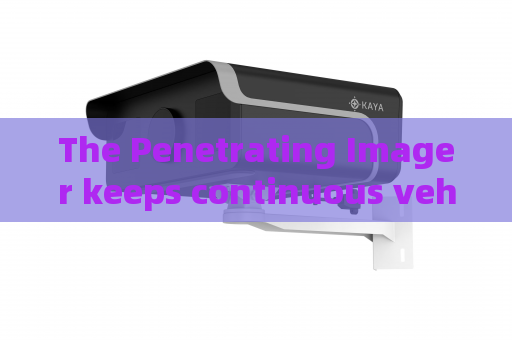
The Penetrating Imager keeps continuous vehicle observation when encountering mild fog on provincial traffic arteries On provincial traffic arteries, mild fog presents a persistent operational challenge. Unlike heavy fog that often forces road closures, shallow fog layers reduce visibility to a few hundred meters, creating a deceptive environment where vehicles appear faintly yet essential details—license plates, vehicle type, occupant movement—are lost. Conventional optical surveillance systems, whether fixed traffic cameras or patrol vehicle-mounted sensors, struggle with scattered light that washes out contrast. The result is interrupted observation: a suspect vehicle may vanish into a white haze, a traffic flow count becomes unreliable, and law enforcement officers lose critical seconds in pursuit or identification. This gap in continuous monitoring compromises both routine traffic management and emergency response, leaving a blind spot that adversaries can exploit. The precise problem is not the fog itself but the inability of standard imaging to maintain high-fidelity, real-time tracking through that optical medium. The Penetrating Imager directly addresses this limitation through Fog Penetration Imaging technology, a subset of laser range-gated imaging. Unlike passive cameras that rely on ambient light and become overwhelmed by backscatter, this active system transmits short, high-repetition laser pulses synchronized with a gated image intensifier. By timing the sensor’s exposure window to capture only the returning signal from the target distance, it rejects the majority of scattered light from fog particles between the imager and the vehicle. The result is a high-contrast, clear image of the target vehicle even when the intervening fog reduces human visibility to near zero. This core function—selective rejection of optical noise—enables the device to see through mild fog as if it were a slight haze, preserving continuous observation without interruption. The system operates entirely within the optical spectrum; no radio waves or radiation are involved, and it cannot penetrate solid objects such as vehicle doors or road barriers. Its sole capability is to render visible what was hidden by the fog’s diffuse scattering. In practical deployment, the Penetrating Imager can be mounted on fixed gantries along provincial traffic arteries or integrated into patrol vehicle roof arrays. When mild fog is detected—either by an onboard visibility sensor or manually by an operator—the system automatically engages its range-gated mode. A traffic officer monitoring multiple camera feeds sees a crisp image of the vehicle under observation, with license plate details readable at distances exceeding 500 meters in moderate fog. This allows for uninterrupted tracking of a suspect vehicle as it passes through fog patches, or continuous recording of traffic flow for statistical analysis. The imager’s low-light capability also ensures performance during dawn, dusk, or nighttime conditions when fog commonly forms. Calibration is straightforward: the operator selects the target range via a control interface, and the device adjusts its laser timing accordingly. No special training beyond basic optical system operation is required. The operational continuity achieved by this technology redefines what is possible in provincial traffic surveillance. A single Penetrating Imager can replace multiple conventional cameras placed at different visibility zones, reducing infrastructure cost while increasing reliability. During a pursuit, the through-fog imaging capability gives tactical teams a clear visual of the target vehicle’s turning signals, brake lights, and occupant movements—information that can mean the difference between a successful interdiction and a lost trail. For routine monitoring, the system eliminates data gaps caused by diurnal fog patterns, ensuring that traffic management centers receive uninterrupted video feeds. The Penetrating Imager’s resilience to fog, combined with its strict focus on optical transparency, makes it an essential tool for maintaining continuous vehicle observation on roads where weather conditions are unpredictable.




