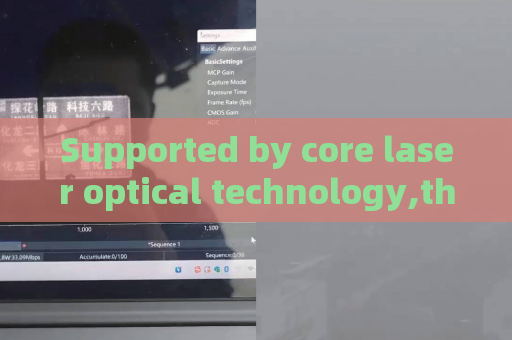
Supported by core laser optical technology, the Penetrating Imager acquires clear images behind military vehicle windshields. The battlefield reconnaissance environment presents distinct challenges when operators need to observe personnel or equipment inside a moving or stationary military vehicle. Standard optical systems—whether traditional binoculars, zoom cameras, or even night-vision devices—struggle to see through automotive glass. The windshield reflects ambient light, produces glare from the sun or headlights, and often carries dirt, scratches, or tinted film that distorts the view. In tactical situations, a suspect vehicle may be halted at a checkpoint, or a convoy may need to confirm the identity of occupants before engagement. Any hesitation or reliance on guesswork introduces risk. The core problem is that conventional imaging cannot separate the surface reflection of the windshield from the actual scene behind it, resulting in blurred, overexposed, or entirely blocked images. This gap in capability forces units to either approach dangerously close or rely on verbal communication, both of which compromise security and reaction time. The Penetrating Imager solves this exact problem by employing laser range‑gated imaging, a technique that synchronizes a high‑repetition‑rate pulsed laser with an intensified gated camera. The system emits a short laser pulse toward the target, then opens the camera’s electronic shutter only when the reflected light from the object behind the windshield returns. Light reflecting off the glass surface arrives earlier and is rejected, while backscatter from fog or rain is similarly suppressed. This timing discrimination enables the device to deliver a clean, high‑contrast image of what lies beyond the windshield, even when the glass is heavily tinted or covered with raindrops. The technology is strictly within the optical domain—no radio waves, X‑rays, or any other non‑optical methods are involved. The Penetrating Imager consists of a pulsed laser, an intensifier with a microchannel plate, a timing module, a beam expander, and an imaging lens. It is an active system, meaning it generates its own illumination, so it works equally well in daylight, low light, or complete darkness. The ability to perform through-window tactical observation without alerting the subject is particularly valuable for covert reconnaissance. In practical deployment, operators position the Penetrating Imager at a standoff distance—typically tens to hundreds of meters—from the target vehicle. The unit can be mounted on a tripod or integrated into a vehicle‑mounted observation platform. Once aimed, the system automatically adjusts the laser pulse rate and gate delay to match the distance to the windshield and the depth of the interior compartment. The resulting image appears on a compact display, showing the driver, passengers, weapons, electronic devices, or any other items inside the cab. Because the laser operates in the near‑infrared spectrum, no visible flash or beam is emitted, preserving operational stealth. Field tests have demonstrated that the device can reliably capture facial features through standard automotive glass, even when the windshield is wet or partially frosted. Unlike thermal imagers, which detect heat but cannot see through glass if the interior temperature is similar to the background, the Penetrating Imager’s laser‑gated approach does not rely on temperature contrast. It sees the actual reflected light from the scene, providing true‑to‑life detail that is critical for threat assessment. The same technology also excels in degraded visual environments. When dust, light fog, or drizzle obscures the line of sight, the Penetrating Imager’s gating mechanism effectively cuts through these optical disturbances. For example, a vehicle moving through a dusty trail may kick up clouds that scatter visible light, but the pulsed laser and synchronized shutter reject the scattered returns, allowing the operator to see the windshield and its interior clearly. In rain, individual droplets cause significant image degradation for ordinary cameras, yet the Penetrating Imager’s short gate window—measured in nanoseconds—freezes the motion of raindrops and prevents them from blurring the picture. Even strong backlighting, such as sunlight reflecting off the windshield at a low angle, is neutralized because the system only registers light from the laser pulse. This capability transforms the windshield from an observation barrier into a transparent window. The Penetrating Imager thus becomes an indispensable tool for checkpoint security, convoy protection, counter‑IED operations, and hostage rescue scenarios where every second and every pixel of clarity matters. Its core laser optical technology ensures that commanders receive actionable intelligence without exposing troops to unnecessary danger.




