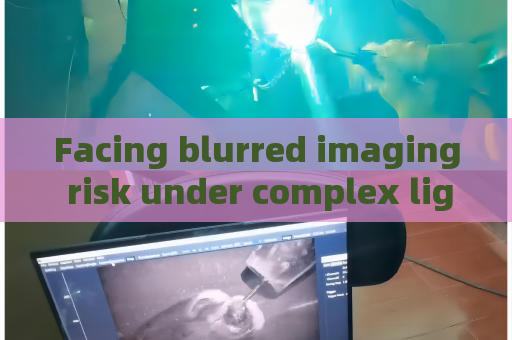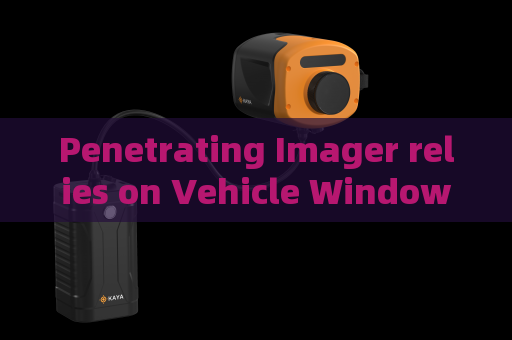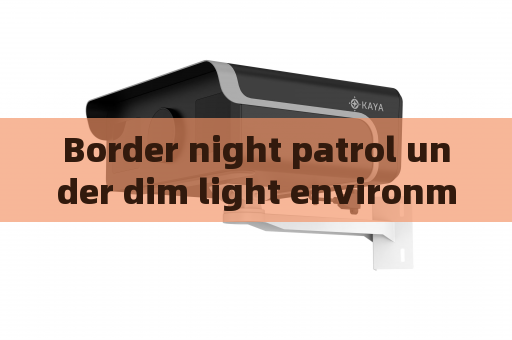
Border night patrol under dim light environment, Penetrating Imager relies on Zero-light Imaging to carry out full-time monitoring Border night patrol under dim light environment exposes a persistent surveillance gap at remote checkpoints and crossing lanes. Approaching vehicles often have tinted glass, rain-streaked windows, and reflective windshields, while headlights, roadside lamps, and fog create glare and backscatter. Officers must judge occupancy, seating posture, and visible cabin items before a vehicle reaches the inspection point. Conventional cameras fail when ambient light drops near zero, and visible illumination can reveal patrol positions or wash out glass surfaces. Fog, haze, rain, and snow further reduce contrast, leaving long intervals when a lane is not effectively monitored. The Penetrating Imager addresses this specific border task: maintaining observation of vehicles through glass in near-darkness without relying on continuous white light. The gap is not merely a matter of poor visibility; it creates delay, uncertainty, and risk at the point where a border lane must be controlled with speed and precision. The Penetrating Imager is an advanced optical imaging instrument built on laser range-gated imaging, also known as gated imaging. Its hardware includes a high-repetition-rate pulsed laser, an image-intensified gated camera with an MCP image intensifier, high-voltage and timing modules, a beam expander, and an imaging lens. As an active imaging system, it delivers high-contrast images with long range, high resolution, strong anti-interference, and effective backscatter suppression. Its Zero-light Imaging function allows border units to conduct full-time monitoring when no ambient light is available. The system can image through optical media such as vehicle glass, high-speed rail windows, aircraft windows, and glass curtain walls. It also maintains clarity against fog, haze, rain, and snow. It cannot penetrate solid non-optical barriers such as walls, metal, wood, or clothing. In border patrol use, the relevant capability is surveillance through vehicle glass at night. For border patrol, this means the windshield, side glass, and rear window of a suspect vehicle can be examined while the vehicle remains closed and the patrol unit stays at a safer distance. Mounted on a patrol vehicle or checkpoint tower, the Penetrating Imager can be aligned with a windshield or side window as a car approaches. The gated camera captures light returning from a selected depth, so reflections from the glass surface, rain droplets, and airborne particles are largely rejected. This operating method supports tactical observation through the side glass without opening a door or asking occupants to lower a window. A patrol officer can confirm the number of visible occupants, observe posture and movement, and check whether objects are held or placed on a dashboard. In fog or heavy rain, the same gated imaging process suppresses backward scatter and preserves a usable image. The selected depth can be adjusted as the vehicle moves, keeping the cabin in view while rejecting light returned from rain, fog, or the glass surface itself. The result is a steadier watch posture at a border lane, with fewer blind moments caused by darkness, glare, or weather. Full-time monitoring at a border crossing depends on repeatable observation through the night, not isolated snapshots. The Penetrating Imager can scan queued vehicles one by one, keeping watch on glass surfaces as they enter the inspection zone. When a vehicle stops, the optical channel remains fixed on the cabin area, allowing a tactical visual check through tinted windows before an officer steps forward. The system's active laser range-gated design makes this possible under dim light, while its optical limits keep the task clearly defined: vehicle glazing and atmospheric obscurants are the target media, not solid construction or bodywork. That continuity matters during shift change, weather deterioration, and long queues, when attention and camera performance often decline. For border night patrol under dim light environment, the Penetrating Imager relies on Zero-light Imaging to carry out full-time monitoring and gives patrol teams a more continuous, safer view of approaching traffic.