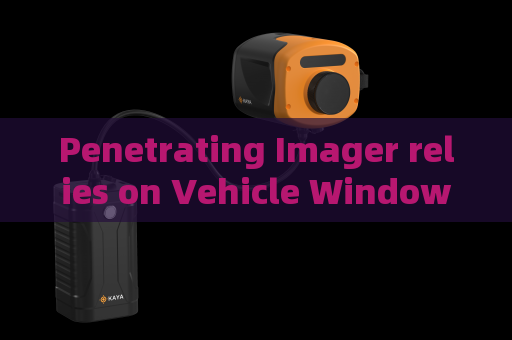
Penetrating Imager relies on Vehicle Window Penetration, supports urban night law enforcement for hidden target monitoring Urban night law enforcement frequently confronts vehicles as closed visual environments. A parked sedan or van may contain a hidden target, but side glass and windshields are dark, tinted, reflective, or covered with condensation. Streetlights, passing headlights, and illuminated signs create severe glare on the glass surface. Conventional cameras and the unaided eye register mostly reflections or a black interior. The officer must decide whether a vehicle is occupied, how many people are inside, where hands are positioned, and whether a weapon or evidence is visible. Opening a door, tapping glass, or directing a flashlight exposes the enforcement position and may provoke a dangerous response. Hidden target monitoring requires a method that observes through the window while preserving distance, cover, and tactical surprise. Penetrating Imager addresses this exact gap in urban night law enforcement, because Vehicle Window Penetration turns automotive glass from a visual barrier into an optical path. through-window tactical observation becomes possible without altering the vehicle or alerting occupants. The relevant function is laser range-gated imaging, also called gated imaging. A high-repetition-rate pulsed laser emits short light pulses. A beam expander shapes the illumination toward the vehicle. An image-intensified gated camera, containing an MCP image intensifier, high-voltage module, and timing module, opens its gate only for the brief interval when light returns from the selected depth. This timing rejects reflections from the outer glass surface, raindrops, fog, haze, and street glare, while accepting light returning from occupants or objects behind the window. The imaging lens forms a high-contrast image. As an active optical system, the imager delivers long range, high resolution, strong anti-interference performance, and effective backscatter suppression. Its Vehicle Window Penetration is limited to optical media such as vehicle glass. The same optical design supports observation through glass under low light and adverse weather. This capability directly serves hidden target monitoring in urban night law enforcement. In field use, officers position the imager on a tripod or vehicle mount at a safe distance from a suspect vehicle. The pulsed laser illuminates the selected window, and the operator adjusts gate delay to match the depth behind the glass. The display reveals the silhouette of a seated occupant, changes in posture, hand movement, and the presence of objects held or placed on a seat. Through-glass surveillance can continue while the vehicle remains closed, locked, and dark. Rain, mist, and wet glass no longer dominate the image, because the gate rejects much of the returning scatter. Streetlights and headlights are suppressed rather than blooming across the frame. The result is a stable tactical picture that helps officers determine whether intervention, further surveillance, or disengagement is appropriate. Recorded imagery can support briefings and documentation. The imager works only with light and optical media. During prolonged urban night law enforcement operations, the imager can check multiple vehicles along a block without approaching each one. Operators compare windshield and side-window returns, confirm occupancy, and watch for sudden movement that suggests flight or aggression. Observation improves when the imager is paired with a stable rest and a narrow field of view, because small movements behind tinted glass become easier to interpret. Vehicle Window Penetration also helps in rain, fog, and snow, where ordinary night optics lose contrast. The system remains an optical tool limited to optical media such as vehicle glass. Its value lies in answering a narrow but critical question—whether a closed vehicle contains a hidden target and what that target is doing. Penetrating Imager relies on Vehicle Window Penetration, supports urban night law enforcement for hidden target monitoring, and gives officers a safer basis for the next tactical decision.