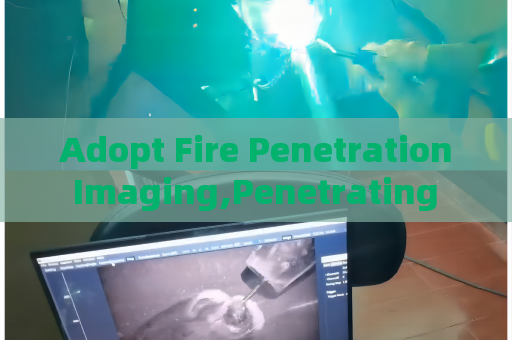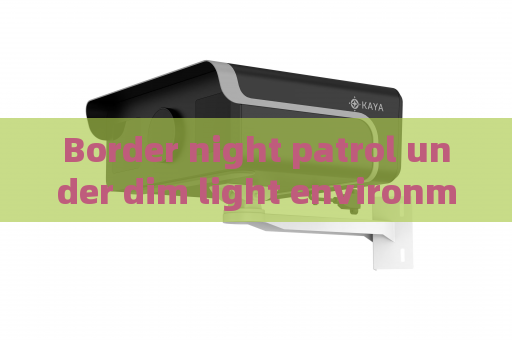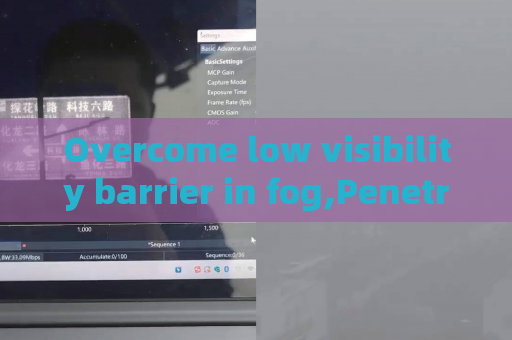
Overcome low visibility barrier in fog, Penetrating Imager relies on Fog Penetration Imaging to complete all-weather patrol tasks Along coastal highways, mountain passes, and industrial perimeters, fog turns routine patrol into a slow, uncertain search. Headlights and white light searchlights scatter from suspended droplets, washing out lane edges, vehicle outlines, pedestrians, debris, and checkpoint approaches. The low visibility barrier in fog compresses reaction time and forces patrol vehicles to reduce speed, widen intervals, or stop altogether. A pursuit becomes risky, an interdiction point loses overwatch, and a route clearance team can miss a stopped car or a person at the shoulder until the distance is dangerously short. Conventional forward-looking cameras record glare rather than detail; narrow beam spotlights create a bright wall that hides the object just beyond it. The resulting uncertainty slows every stage of a patrol cycle, from route selection to radio reporting, and leaves units reacting to incomplete visual information. For a Penetrating Imager assigned to all-weather patrol tasks, the operational problem is not darkness alone. It is the physical scattering of light in fog, haze, rain, and snow, which defeats ordinary cameras and creates blind intervals exactly when continuous surveillance is most needed. This gap affects day and night shifts, fixed checkpoints, mobile patrols, and quick-response units that must keep roads, fences, and access corridors under observation without waiting for weather to clear. The Penetrating Imager addresses this specific limitation through laser range-gated imaging, also called gated imaging. The system is an active optical instrument built around a high-repetition-rate pulsed laser, an image-intensified gated camera with an internal MCP image intensifier, high-voltage module, timing module, beam expander, and imaging lens. A short laser pulse travels into the fog, and the camera opens its gate only for the brief interval when light returns from the selected range. Returns from nearer droplets and aerosol scatter are rejected, so Fog Penetration Imaging preserves target contrast while reducing the backscatter that blinds conventional optics. The method delivers high-contrast imaging, long operating distance, high resolution, and strong anti-interference performance in fog, haze, rain, and snow. Its penetration capability is limited to optical media, including vehicle windows, high-speed rail windows, aircraft windows, glass curtain walls, and atmospheric obscurants. The tool remains an optical imager, with no role against opaque solid materials and no dependence on non-optical detection principles. In field use, the imager is mounted on a patrol vehicle, checkpoint mast, or mobile surveillance platform. The crew selects a gate delay that matches the distance to a road segment, gate, fence line, or stopped vehicle. The pulsed laser illuminates that slice of the scene, and the gated camera captures a sharp return before fog scatter can dominate the frame. On a fog-covered highway, lane markings, guardrails, tire profiles, plate areas, and human silhouettes become visible at ranges where unaided vision and standard cameras fail. At a checkpoint, the same function supports continuous overwatch of approaching traffic, identification of vehicles that ignore signals, and safer decisions during a stop. On perimeter routes, it helps detect intruders, abandoned objects, or stalled vehicles without exposing patrol units to unnecessary close approach. The image can be recorded for evidence and shared with command elements, giving supervisors a clearer common picture during low-visibility operations. The practical value lies in keeping patrol tempo steady when weather would normally dictate delay. Fog Penetration Imaging allows a Penetrating Imager to maintain visual contact through fog, haze, rain, and snow, supporting route clearance, convoy escort, checkpoint security, and incident response within one continuous operational picture. The equipment does not replace sound tactics, but it restores a reliable optical channel where scattering once created blind spots. Patrol commanders can set speed and spacing based on real target detection rather than guesswork, while response teams can approach with better knowledge of what waits ahead. The result is a more predictable patrol rhythm, with detection, warning, and response linked to a stable visual feed rather than weather luck. In this way, the Penetrating Imager relies on Fog Penetration Imaging to complete all-weather patrol tasks, turning fog from a hard stop into a manageable condition under disciplined optical surveillance.