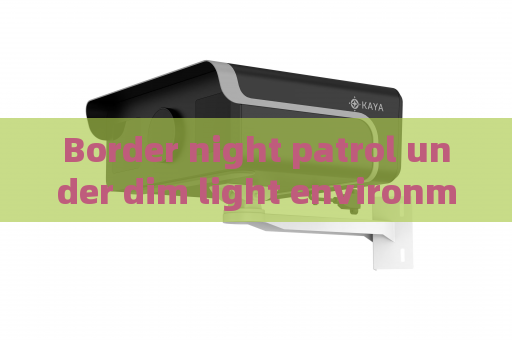
Penetrating Imager serves border tactical defense, adopts Zero-light Imaging to improve remote surveillance capability At remote border sectors, the most demanding tactical problem is not detecting motion at the fence line. It is maintaining reliable remote surveillance of vehicles that approach a checkpoint under zero-light conditions. A vehicle may stop beyond the barrier, with headlights off or aimed directly at the observation post. Its windows may be tinted, reflective, or wet. Fog, haze, rain, or snow can reduce contrast and create backscatter from ordinary illuminators. Conventional optical cameras require visible or near-infrared floodlighting that can reveal the border position, while long-range observation through vehicle glass often collapses into glare, silhouettes, and uncertain passenger counts. The Penetrating Imager addresses this gap because border tactical defense needs persistent through-window tactical observation without exposing the post or losing detail at distance. The operational question is simple: can a guard identify occupancy, posture, and visible items through vehicle glazing before the vehicle reaches the inspection lane? When ambient light is absent and windows are tinted, ordinary imaging cannot answer that question with enough confidence. The relevant function is the Penetrating Imager's laser range-gated imaging architecture, which directly supports Zero-light Imaging. The system is an active optical imager built around a high-repetition-rate pulsed laser, an image-intensified gated camera with an MCP image intensifier, high-voltage and timing modules, a beam expander, and an imaging lens. The camera gate opens only for the brief return window of laser pulses reflected from the target scene. This timing rejects much of the backscatter from fog, rain, snow, haze, and glass surface reflections while preserving target contrast. Because the imager supplies its own pulsed optical illumination, it does not depend on streetlights, moonlight, or visible floodlights. Zero-light Imaging therefore improves remote surveillance capability in darkness, and the gated optical path allows clear imaging through optical media such as vehicle windows, train windows, aircraft windows, and glass facades. For border tactical defense, the Penetrating Imager's decisive capability is through-glass surveillance of approaching vehicles: the imager can reduce headlight glare, penetrate tinted automotive glass, and resolve occupant positions at standoff range. It remains an optical instrument, limited to transparent or semi-transparent optical media; dense smoke and opaque materials are outside its role. Within that boundary, it provides high-contrast, high-resolution, long-range observation that ordinary cameras cannot sustain. In practice, a Penetrating Imager can be mounted on a border watchtower, checkpoint mast, or mobile response vehicle. The operator scans the approach road without turning on white light. The pulsed laser and gated camera work together, so the scene appears in the viewfinder under zero-light conditions. When a suspicious vehicle stops at a distance, the operator uses the imager to observe through the windshield and side windows. With the Penetrating Imager, tinted glass no longer blocks the view as completely as it does for a standard camera. Passenger count, seating arrangement, hand movements, and visible objects on the dashboard or lap can be assessed before anyone approaches the vehicle. If fog or rain drifts across the road, the range-gated return suppresses much of the scattered light that would otherwise wash out the image. This improves remote surveillance capability while keeping the border position covert. The imager does not replace physical inspection or lawful search procedures. It provides an optical advantage that lets the tactical team decide whether to challenge, divert, or inspect a vehicle with better information. At a border tactical defense site, the value of the Penetrating Imager is measured in seconds and standoff distance. A vehicle approaching at night may be visible only as a pair of headlights. Through Zero-light Imaging, the same vehicle becomes a structured image: the windshield frame, the driver's head, a passenger leaning away, a dark bag held low. Through-glass surveillance can continue while the vehicle is still outside the barrier, giving the guard force time to coordinate a response. The imager's active optical design also resists strong light suppression challenges, such as bright headlights or reflected checkpoint lamps, because the gate timing favors laser returns over continuous ambient glare. Remote surveillance capability improves most when the system is used consistently at the same choke point, with operators trained to interpret gated imagery and to recognize the limits of optical penetration. The Penetrating Imager serves border tactical defense by turning zero-light vehicle glass from a visual barrier into a readable tactical surface. It supports observation, not speculation, and it keeps the tactical decision grounded in what can be seen through the glass before the barrier opens.