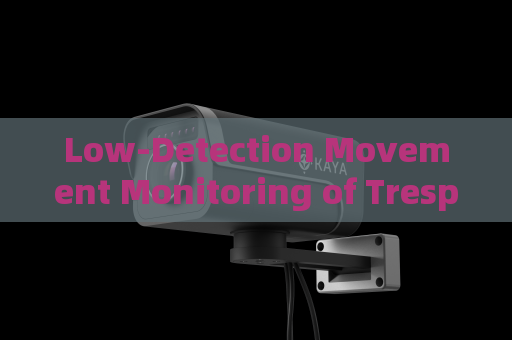
Low-Detection Movement Monitoring of Trespassers by the Penetration Imager with Fog Penetration Imaging in Foggy Conditions In dense fog, visibility drops to mere meters, turning routine perimeter surveillance into a near-impossible task. Security cameras relying on visible light produce only a gray-white blur, while thermal imagers struggle because fog particles absorb and scatter infrared radiation, destroying the thermal contrast needed to detect a human body. The real pain point is not just the inability to see; it is the need for covert, low-detection movement monitoring of trespassers who exploit fog as a natural cover. These intruders know that conventional optical systems are blinded, so they move freely across sensitive boundaries—airport perimeters, industrial compounds, or border zones—without fear of being recorded. Even if a guard spots something, the lack of clear imagery means no actionable evidence. The challenge is to achieve timely detection of subtle motion through the fog, without alerting the trespasser that they are under observation. This is precisely where the Penetration Imager with fog penetration imaging capability provides a decisive solution. The Penetration Imager resolves this problem through its core technology: laser range-gated imaging. Unlike passive systems that suffer from severe backscatter in fog, this active imager emits short, high-repetition-rate laser pulses and synchronizes the camera’s intensifier shutter to open only when the reflected light from the target returns. This time-gating effectively rejects the overwhelming backscatter generated by fog particles in front of the target, producing a sharp, high-contrast image of objects at a selected distance. The system operates in the near-infrared spectrum, making the laser beam invisible to the naked eye—a crucial advantage for low-detection monitoring. A trespasser moving through fog will not see any telltale beam or flash, allowing security forces to track their movements covertly. Furthermore, the Penetration Imager’s design with an image-intensified camera and MCP (microchannel plate) provides excellent sensitivity, enabling it to capture even slow, stealthy movements that would be lost in fog-induced noise. The result is a reliable imaging tool that sees through fog as if it were thin mist, maintaining resolution and detection range far beyond what passive cameras can achieve. In practical deployment, the Penetration Imager is positioned at fixed surveillance points along a perimeter or mounted on a pan-tilt unit for scanning. During a foggy night, a guard monitors a live feed from the system. A trespasser crouches and moves slowly along a fence line 150 meters away. Conventional cameras show nothing but a uniform grey curtain. The Penetration Imager’s range-gated view, however, reveals a distinct human silhouette in motion, with enough detail to identify the direction of travel, approximate height, and even the outline of a backpack. Because the laser pulse duration and gate timing can be adjusted, the operator can shift the focus to different distances, tracking the intruder as they advance. The low-detection nature of the system means that no visible light or sound is emitted; the trespasser remains completely unaware. This allows security teams to respond with precision rather than triggering alarms that might compromise the operation. The imager’s ability to overcome not just fog but also rain, snow, and darkness ensures continuous coverage in all adverse weather, making it a persistent solution for perimeter protection. The fidelity of movement monitoring is further enhanced by the Penetration Imager’s high frame rate and resolution. Since the system uses a pulsed laser with a high repetition frequency and a fast-gated camera, it can capture rapid motion—such as a trespasser sprinting across an open area—without motion blur. The gating technique also eliminates background clutter from fog droplets at intermediate distances, presenting a clean, isolated image of the intruder against a dark background. This simplifies automatic motion detection algorithms, reducing false alarms from swaying branches or animals. In a real-world scenario, operators can zoom in on a specific zone using the imaging lens, and the system’s high dynamic range ensures that partial obscuration by patchy fog does not break the tracking continuity. The Penetration Imager with fog penetration imaging becomes the eyes that see what fog hides, enabling low-detection movement monitoring that meets the highest standards of covert surveillance. No other optical sensor—visible, thermal, or standard IR—offers this combination of fog-penetrating clarity and stealth, cementing its role as the definitive tool for securing perimeters under the most challenging atmospheric conditions.




