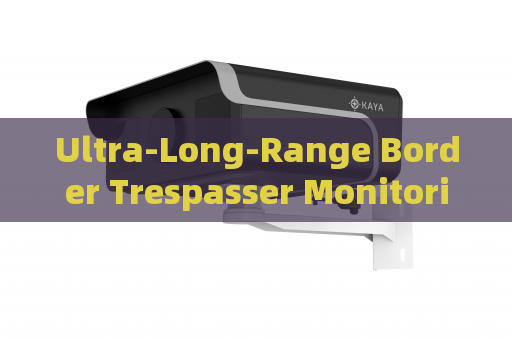
Ultra-Long-Range Border Trespasser Monitoring by the Penetration Imager with Fog Penetration Imaging in Severe Weather Border surveillance along remote, open terrain faces a persistent challenge: detecting trespassers attempting to cross under cover of dense fog, heavy rain, or blizzard conditions. Traditional optical systems—daylight cameras, thermal imagers, or even radar-based tripwires—struggle to maintain performance when atmospheric visibility drops below fifty meters. Fog scatters visible and infrared light, creating a bright veil of backscatter that masks faint human targets at distances beyond one hundred meters. Thermal imagers, while effective in clear nights, become nearly useless in fog because water droplets absorb long-wave infrared radiation. Radar can detect movement but cannot confirm whether the object is a human or an animal without supplementary visual confirmation, and it often fails to differentiate between a crawling trespasser and ground clutter. This gap in capability forces border patrol agents to rely on close-range physical patrols or ground sensors, reducing response time and increasing risk to personnel. The operational need is clear: a system that can see through fog and rain over ultra-long ranges, providing an actionable visual identification of a trespasser before they reach the border fence. The Penetration Imager directly addresses this operational gap through its laser range-gated imaging technology. Unlike passive cameras that receive all scattered light simultaneously, the Penetration Imager emits a high-repetition-rate pulsed laser and synchronizes its intensified gated camera to open only when the reflected light from a specific distance returns. This gating mechanism rejects nearly all backscatter from fog particles between the imager and the target, effectively cutting through the optical haze. The system’s MCP image intensifier and high-voltage timing module allow it to see through fog, rain, snow, and even glass windows—anything that is an optical medium rather than a solid barrier. For border monitoring, this means a trespasser crawling through a fog bank at two kilometers can be imaged with high contrast, while the intervening fog layers remain invisible. The Penetration Imager’s laser operates at an eye-safe wavelength, and the system’s built-in beam expander and imaging lens deliver a narrow field of view optimized for long-range detection up to several kilometers, depending on atmospheric conditions. In practical deployment, a Penetration Imager is mounted on a fixed border observation tower or a stabilized tripod near a known smuggling route. The operator selects a target range zone—for example, 1,500 meters out—and adjusts the gate delay accordingly. As a trespasser moves into that zone, the system’s real-time image stream shows a clear, grayscale silhouette against a dark background, even when ambient fog reduces human visibility to less than fifty meters. The ability to penetrate fog enables continuous monitoring through day and night, since the active laser illumination does not rely on ambient light. Border patrol teams can then coordinate a response with confidence, knowing that the visual identification is genuine. Unlike passive thermal imagers that require temperature differences, the Penetration Imager works equally well on a cold, wet trespasser wearing rain gear, because it relies on reflected laser light, not heat. The operational benefit extends to ultra-long-range detection in severe weather events such as coastal fog or prairie blizzards, where traditional surveillance systems are effectively blind. A single Penetration Imager can cover a sector of border that would otherwise require multiple ground sensors or patrol vehicles. The system’s high-resolution imaging also allows operators to differentiate between a lone walker and a group dragging cargo, or between a human and a deer, at ranges where thermal signatures blend together. By maintaining a constant lock on the target, the Penetration Imager provides actionable intelligence for intercept teams, reducing false alarms and wasted deployments. This capability transforms border security in regions prone to fog, rain, or snow, offering a reliable tool for ultra-long-range border trespasser monitoring that was previously unattainable with conventional optics.




