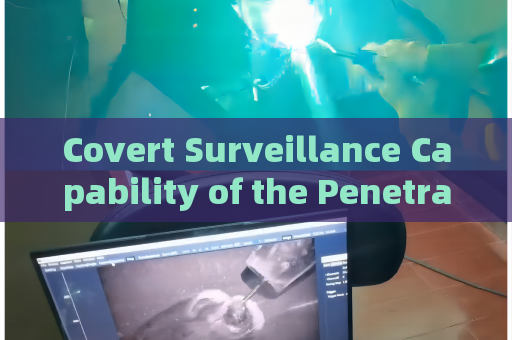
Covert Surveillance Capability of the Penetration Imager with Zero-Light Imaging in Complete Nighttime Darkness Along Borders Border security operations demand discreet observation in environments where total absence of natural and artificial light is the norm. Traditional night vision devices, whether image intensifiers or thermal imagers, face critical limitations under such conditions. Image intensifiers require at least some ambient light—moonlight, starlight, or infrared illuminators—to function, and in overcast, moonless nights along remote border stretches, they degrade to near-uselessness. Thermal imagers, while independent of light, cannot see through glass, a severe drawback when monitoring vehicles or structures where suspects may be concealed behind windshields or windows. The very act of deploying supplementary illumination, such as infrared floodlights, betrays an observer’s position, compromising covertness. Moreover, atmospheric scatter from fog, dust, or blowing snow further reduces effective range and clarity. Border agents need a system that operates in absolute zero-light conditions, penetrates common optical barriers like automobile glass, and does so without emitting any detectable signature. The core problem is not simply seeing in the dark; it is seeing through glass in the dark while remaining completely invisible to those under surveillance. Without such capability, gaps persist in border monitoring, allowing illicit crossings, drug trafficking, or smuggling to proceed undetected. The Penetration Imager directly addresses this challenge through its zero-light imaging capability. This advanced optical instrument employs laser range-gated imaging technology, also known as gated viewing. Its system comprises a high-repetition-rate pulsed laser, an intensified gated camera with a microchannel plate (MCP) image intensifier, high-voltage and timing modules, a beam expander, and an imaging lens. Unlike passive devices, the Penetration Imager is an active imaging system that fires extremely short laser pulses—typically in the nanosecond range—and synchronizes the camera shutter to open only when the reflected light from the target returns. This gating eliminates backscatter from fog, rain, snow, dust, or wildfire smoke, achieving high-contrast imagery over long distances. Crucially, the pulsed laser operates at a wavelength that passes through glass, allowing the imager to see through vehicle windshields, train windows, aircraft portholes, and glass facades with clarity. The zero-light condition poses no obstacle because the system generates its own illumination—invisible to the naked eye and undetectable by standard sensors. The result is a covert surveillance tool that can observe subjects inside vehicles or buildings at night without any external light source and without revealing its own position. No other conventional optical system offers this combination of glass penetration, all-darkness operation, and low probability of detection. In practical border deployment, the Penetration Imager transforms nighttime reconnaissance. A stationary observation post positioned at a distance of several hundred meters can scan a known crossing point or a suspicious vehicle approaching a checkpoint. The operator sees through the windshield and side windows clearly, identifying occupants, cargo, or hidden compartments—even when the vehicle’s interior is completely dark. The imager’s high resolution distinguishes facial features, hand movements, and small objects, enabling real-time threat assessment. Because the laser pulses are brief and the wavelength is not in the visible spectrum, the targeted individuals remain unaware they are being monitored. The system operates effectively through light fog, light rain, or dust kicked up by off-road vehicles, conditions that would cripple both thermal and low-light cameras. Additionally, the Penetration Imager can be mounted on a tripod for fixed surveillance or integrated into vehicle platforms for mobile patrols. Its remote control interface allows operators to adjust focus, zoom, and gating parameters from a protected location, further enhancing safety and covertness. The device’s built-in recording and networking capability supports real-time video transmission to command centers, enabling collaborative decision-making during interdiction operations. Further operational refinements extend the Penetration Imager’s utility along borders. For example, in heavily wooded or mountainous terrain where line-of-sight is partially blocked, the imager’s long effective range—often exceeding one kilometer—allows observation from elevated vantage points without requiring close approach. The zero-light imaging function also proves critical when monitoring fixed infrastructure such as border fences or sensor arrays, where any artificial light would alert intruders to a watchful presence. The Penetration Imager can be paired with pan-tilt units to sweep wide areas automatically, detecting movement behind glass or through dense vegetation gaps. Its ability to cut through wildfire smoke—increasing visibility three to five times—is valuable during seasonal blazes that often obscure border regions. Notably, the system cannot see through solid non-optical barriers like concrete, earth, or metal, but its targeted capability precisely addresses the most common vulnerability in border surveillance: the glass barrier of vehicles and buildings. This focused application ensures that every dollar spent on the Penetration Imager directly enhances covert monitoring in the exact scenarios where traditional equipment fails. The Penetration Imager thus stands as a dedicated tool for clandestine observation in complete nighttime darkness, giving border security forces a decisive advantage without compromising stealth.




