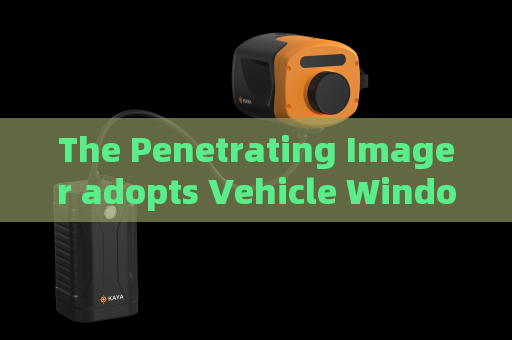
The Penetrating Imager adopts Vehicle Window Penetration to carry out exterior glass observation of building fire for law enforcement. In the chaos of a building fire, law enforcement officers face a stark dilemma: the interior of the structure is a lethal environment of heat, smoke, and collapsing debris, making direct entry impossible for initial assessment. Exterior observation through building windows is equally challenging—fire-induced turbulence, flickering flames, and heavy smoke create optical chaos that renders standard cameras and binoculars useless. Thermal imagers, while useful for detecting heat signatures through smoke, cannot see through glass; they pick up the reflected heat of the fire itself or the hot window pane, obscuring any view of occupants or hazards beyond. The most critical vulnerability, however, is the through-glass surveillance barrier posed by vehicle windshields and side windows when officers must stage reconnaissance from patrol cars. A fire truck or police cruiser parked at a safe distance cannot rely on its own windows to see into the burning building—the same glass that protects the crew becomes an opaque wall. This operational gap delays situational awareness, risks misdirected rescue efforts, and leaves commanders blind to rapidly evolving fire dynamics. The Penetrating Imager directly addresses this bottleneck. Unlike conventional optical devices, the Penetrating Imager is an active imaging system based on laser range-gated imaging technology. It consists of a high-repetition-rate pulsed laser, an intensified gated camera (incorporating an MCP image intensifier, high-voltage module, and timing electronics), a beam expander, and an imaging lens. By synchronizing the laser pulse with the camera’s gate, the system selects only light reflected from a specific distance, rejecting backscatter from flames, smoke particles, and—critically—the glass itself. This allows the Penetrating Imager to see through vehicle windows and building glass panes as if they were invisible. In the context of building fire observation, the device can be aimed through a patrol car’s windshield or side window, capturing clear images of the fire scene beyond the glass. The technology also incorporates Vehicle Window Penetration as a core capability, meaning the system is optimized for the curvature, thickness, and tinting of automotive glazing. Even under heavy fire glow or intense ambient light, the gate-timing mechanism suppresses the blinding effect of flames, a feature known as Strong Light Suppression Imaging that preserves contrast and detail on the target interior. In practice, an officer can deploy the Penetrating Imager from inside a law enforcement vehicle parked 50 to 100 meters from the burning building. Without leaving the safety of the vehicle, the operator aims the device through the car’s own side window—perhaps a tinted sedan window or a heavy-duty SUV windshield—and acquires a real-time view of the building’s interior through the building’s glass facade. The imager enhances visibility by three to five times in fire conditions, cutting through the shimmer of heat waves and the light haze of low-level smoke. This allows the commander to identify trapped civilians, locate the fire’s origin, assess structural collapse risks, and coordinate entry points—all while remaining behind protective vehicle glass. The system’s ability to perform tactical visual check through tinted windows is especially valuable: many commercial buildings and residential towers use reflective or darkly tinted glass that blocks standard optics, but the Penetrating Imager’s gated laser can still penetrate these coatings and reveal the interior layout. The operational advantage extends to night and low-light scenarios. Because the Penetrating Imager is an active system, its own pulsed laser illuminates the target, enabling Zero-light Imaging capability. A fire scene at midnight, with streetlights disabled by the emergency, presents no obstacle. The imager’s laser works silently and invisibly to the naked eye, providing covert observation that does not alert occupants or suspects inside the building. This is particularly useful for law enforcement responding to a fire that may involve arson or a hostage situation; the ability to see through glass from a vehicle without announcing the observation position preserves the element of surprise. The device’s high resolution and long working distance—permitted by the collimated laser beam and sensitive intensified sensor—mean that even small details such as a fallen victim’s hand signal or a door’s lock status are resolvable. The Penetrating Imager never claims to see through solid walls or dense smoke; but for the specific, pervasive problem of exterior glass observation in building fire scenarios, it converts a vehicle windshield from a liability into an observation platform, giving law enforcement the eyes they need to act decisively.




