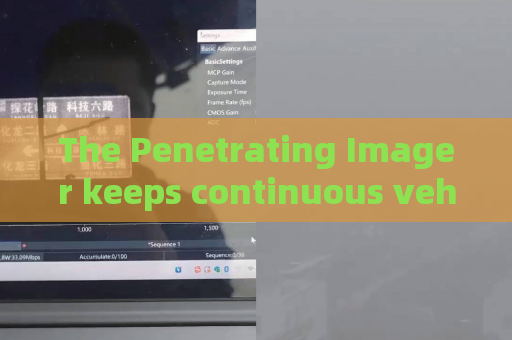
The Penetrating Imager keeps continuous vehicle observation when encountering mild fog on provincial traffic arteries On provincial traffic arteries, mild fog presents a persistent and deceptive challenge for continuous vehicle observation. Unlike dense fog that forces complete shutdowns, light mist reduces visibility just enough to obscure critical details—vehicle colors, license plates, occupant movements—while still allowing traffic to flow. Standard optical cameras fail under these conditions, their sensors overwhelmed by scattered light that washes out contrast and creates halos around headlights. Thermal imagers, though effective in total darkness, struggle in fog because water droplets absorb and scatter infrared radiation, producing blurred, low-contrast images that cannot distinguish one vehicle from another. Radar systems can detect presence but cannot identify what is inside a car or read a plate. The operational gap leaves law enforcement and traffic management unable to maintain the continuous, reliable observation required for security checks, pursuit tracking, or situational assessment on provincial routes where stopping every vehicle is impractical. The Penetrating Imager directly addresses this vulnerability by employing laser range-gated imaging technology, an active optical method that separates returning signal light from scattered background illumination, enabling clear target acquisition even through light fog. The solution lies in the Penetrating Imager’s ability to perform through-window tactical recce under compromised atmospheric conditions. Its core architecture—a high-repetition-rate pulsed laser paired with an image-intensified gated camera—synchronizes laser pulses with the camera’s shutter timing. This gating mechanism allows only light reflected from the target at a precise distance to reach the sensor, while overwhelmingly rejecting backscatter from fog particles between the imager and the vehicle. The result is a high-contrast image that cuts through the mist, revealing not just the vehicle’s shape but also details such as tinted windows, driver posture, and interior objects. Unlike passive systems, this active approach maintains full operational capability in low-light or twilight conditions common during early-morning fog. The Penetrating Imager’s laser operates within the visible-to-near-infrared spectrum, ensuring no radioactive hazard or detection risk, while its selective gating eliminates the need for high-power floodlights that would alert subjects. In practical deployment on provincial arteries, the Penetrating Imager maintains continuous vehicle observation without interruption as light fog rolls in. An operator at a fixed checkpoint or in a moving patrol vehicle can aim the device at oncoming traffic and instantly acquire crisp images of vehicles 200–500 meters away, even when unaided vision sees only a diffuse glow of headlights. The system’s real-time feed displays license plates clearly enough for automated recognition, and the through-glass capability reveals occupants moving inside the cabin—critical for identifying suspicious behavior before a vehicle reaches the checkpoint. Because the technology relies on optical transmission through glass, it works seamlessly with car windows, windshields, and even heavily tinted aftermarket films that defeat standard cameras. The operator does not need special training; the unit offers a digital sight with automatic gain adjustment, and the gating distance can be tuned on-the-fly to follow a target as it approaches, maintaining lock through patches of denser mist. This continuous observation capability transforms fog from a tactical liability into a manageable condition. On provincial routes where traffic flows at moderate speeds and stops are infrequent, the Penetrating Imager provides the only reliable method to track a vehicle’s identity and occupant activity without physical interdiction. When a suspect vehicle disappears into a fog bank, standard surveillance loses it; the Penetrating Imager, by contrast, keeps the vehicle’s license plate and profile visible through the mist, enabling handoff to the next observation post. The system operates covertly—no visible beam, no audible signal—making it ideal for discreet monitoring at rural checkpoints or bridge approaches. The Penetrating Imager thus ensures that mild fog does not create a blind spot on provincial traffic arteries, maintaining the chain of observation that underpins effective traffic law enforcement and public safety.




